Launch Economics
Part of Creator brand product expansion
Comparing a limited collaboration with a permanent product
Compare a limited product collaboration with a continuing range item through customer promises, asset rights, operating work and exit plans.
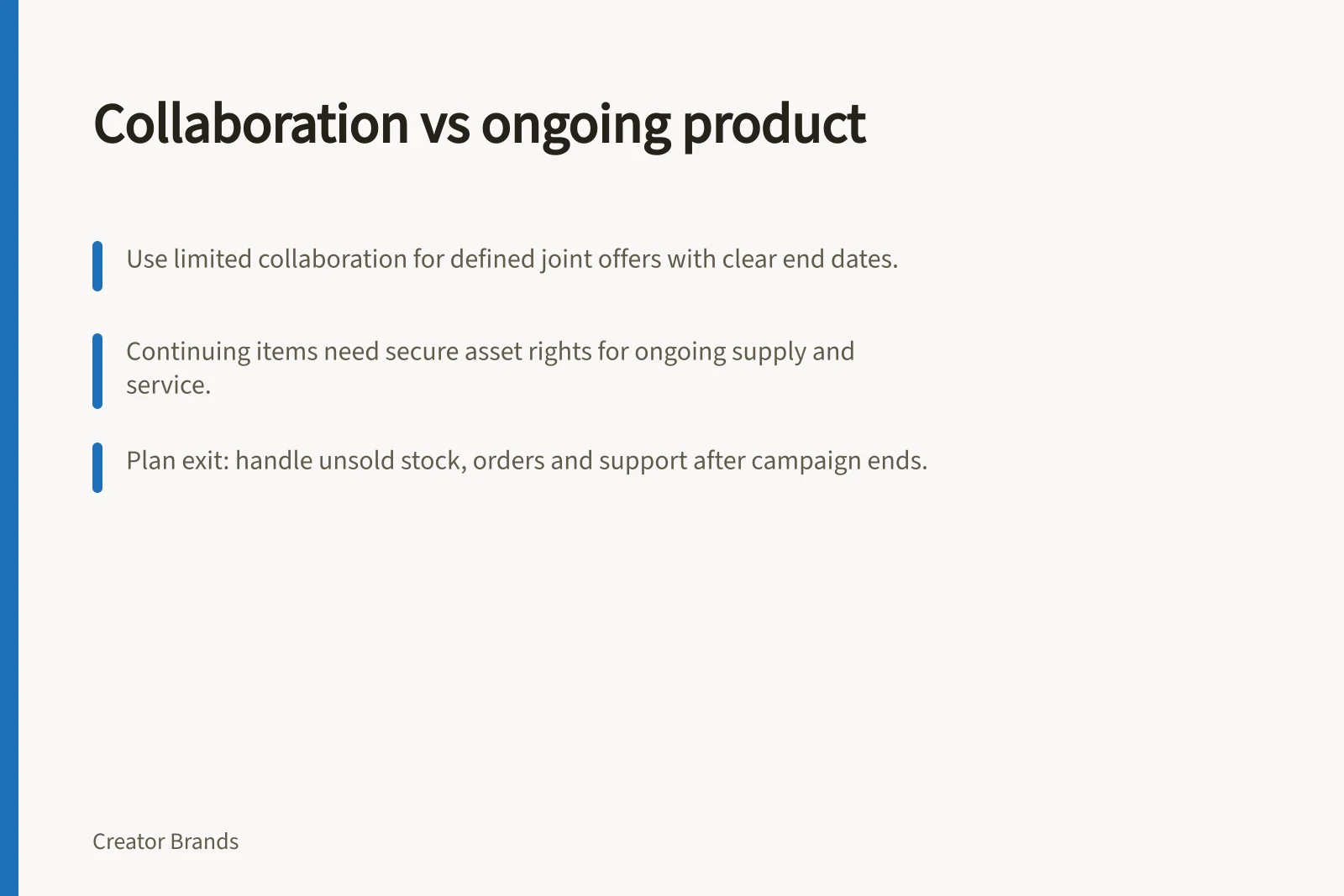
Use a limited collaboration when a defined joint offer can answer a useful question and the partners can agree how it ends. Use a continuing range item when customer need, supply, service and asset rights support ongoing sale.
These choices describe the offer’s duration and work. The word ‘collaboration’ does not identify the seller or settle ownership.
Compare the commitments
| Decision | Limited collaboration | Continuing range item |
|---|---|---|
| Customer promise | State the item, release period and real limits. | Keep availability and product information current after launch. |
| Work after launch | Assign open orders and product problems after promotion ends. | Assign replenishment, changes and continuing service. |
| Assets | Agree permitted uses of names, designs and content, including the end of use. | Secure rights that cover the intended continuing uses. |
| Next decision | Review whether to repeat, revise or finish. | Review whether the item still earns its place in the range. |
These are planning distinctions, not standard contract terms. A collaboration can be renewed and a continuing item can later be retired. A limited run does not automatically cost less or prove weaker demand.
Limited Collaboration vs Continuing Range Item: Key Differences
- Customer promiseState the item, release period and real limits.
- Work after launchAssign open orders and product problems after promotion ends.
- AssetsAgree permitted uses of names, designs and content, including the end of use.
- Next decisionReview whether to repeat, revise or finish.
- Customer promiseKeep availability and product information current after launch.
- Work after launchAssign replenishment, changes and continuing service.
- AssetsSecure rights that cover the intended continuing uses.
- Next decisionReview whether the item still earns its place in the range.
Give the collaboration a question and an end
State what the joint release is meant to learn, such as whether buyers value a particular design or related use. Define the exact item, version, quantity or order window and what a buyer will receive.
If a partner makes or sells it, identify the seller. Agree how enquiries, faults and outstanding orders will be handled.
Identify existing names, trade marks, designs and content, any third-party material and anything the project will create. Agree who may use each asset on packaging and in promotion, for which products and channels, and what happens at the end.
IP Australia recommends settling existing and new IP, ownership and licensing in collaborations. Obtain advice on the actual agreement before relying on a campaign credit as permission for later uses.
Describe a limit accurately. A quantity cap, an ordering deadline and the end of a partner’s permission are different facts. If a repeat remains possible, do not call the first release a final opportunity.
Planning a Collaboration: Key Steps
- Define the purposeState what the joint release is meant to learn, such as buyer interest in a design or use.
- Specify the offeringIdentify exact item, version, quantity, order window, and what buyers receive.
- Confirm seller identityIf a partner makes or sells it, identify the seller clearly.
- Manage intellectual propertyAgree on use of existing and new IP, ownership, and licensing terms.
- Set clear limitsUse quantity caps, ordering deadlines, or partner permission end dates—do not label as 'final opportunity' if repeat is possible.
Test the case for a continuing item
A successful announcement is not enough. Ask whether buyers understood the product beyond the partner campaign, whether the approved item can be supplied again and whether ordinary order and support work is manageable.
Review fulfilled orders, cancellations, returns and enquiries against the stock and terms actually offered. A small sell-out describes that allocation, not future demand.
Use current quotes and a cautious sales scenario to assess another run. Recheck product claims and delivery wording when versions change.
If a partner’s asset is essential, continuing rights must cover the proposed continuing sale. A product can remain a collaboration while becoming part of a continuing range, but the agreements and customer promise must support that arrangement.
Plan the exit for customers
Before either offer opens, decide how unsold stock, paid orders, product information, promotional assets and the service contact will be handled when the campaign or arrangement ends. Plan how customer enquiries about product problems will be handled.
Record whether the next step is to finish, repeat on revised terms or develop a continuing item, and what evidence and rights each option requires.
Exit Planning for Customers
- Before launchDecide how unsold stock, paid orders, product info, promotional assets and service contact will be handled post-campaign.
- Post-campaignPlan how customer enquiries about product problems will be managed.
- Next stepsRecord whether to finish, repeat on revised terms, or develop a continuing item.
- Evidence and rightsEnsure each option has required evidence and legal rights in place.