Product Development
Creator brand product expansion
Decide whether a creator product range should expand by comparing customer roles, substitution risk, operating capacity and cash across the range.
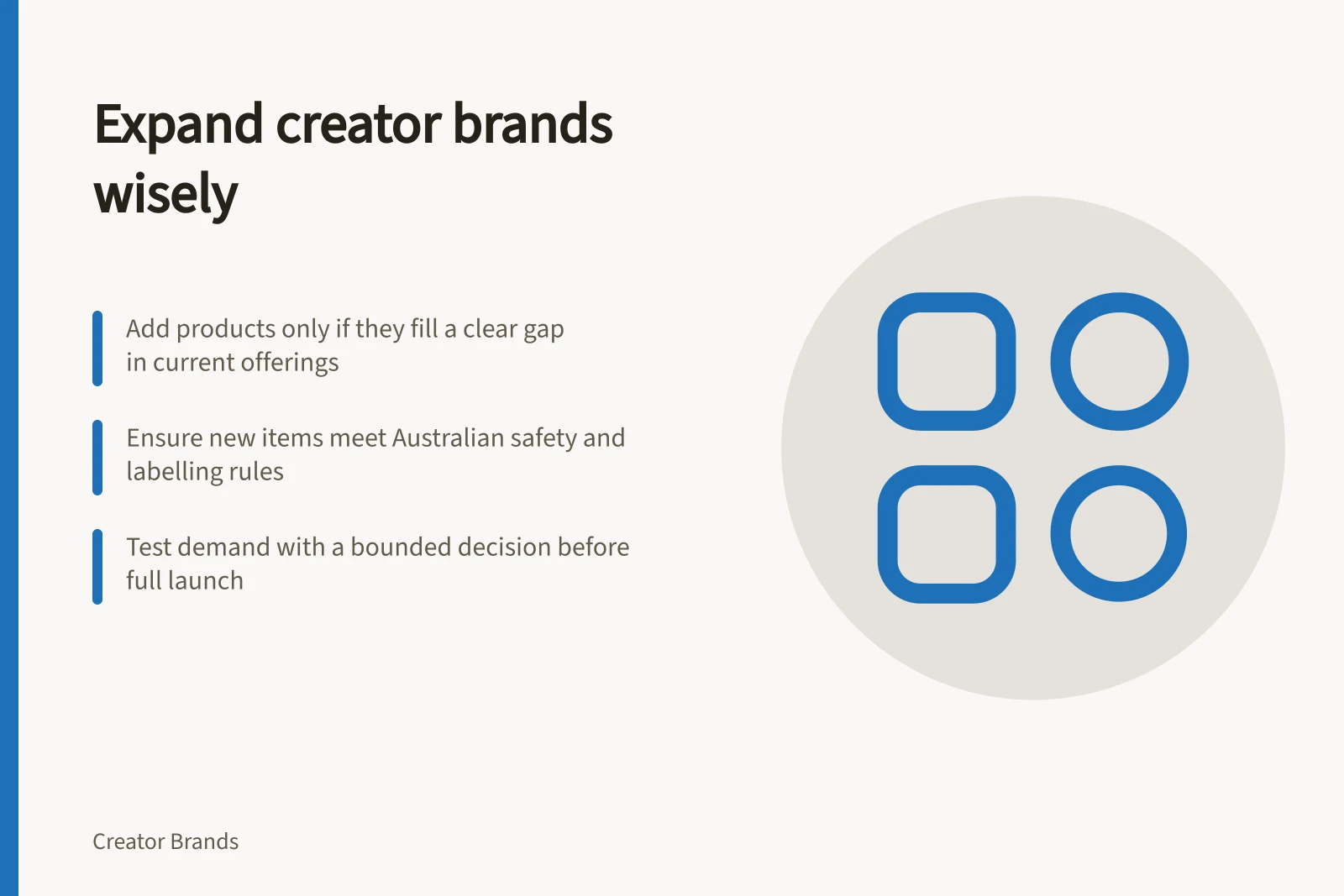
Expand an existing creator product range only when an addition has a clear job alongside the current offer and the brand can supply and support both. Another item can reach a new buying situation, deepen use of the first product or replace sales the range already earns. Reaching a new buying situation may add demand; replacing sales can shift demand within the range without growing it.
Name the gap in the range
Start with the current product's customer, occasion and promise. Describe the proposed addition without the creator's name: who would choose it, when, and what they would buy or use instead. Then decide which role it would play.
| Addition | Portfolio question | Main commitment to examine |
|---|---|---|
| Size, pack or format | Does it serve a use the current version misses, or mostly shift existing orders? | More variants, stock records and fulfilment choices |
| Complementary item | Does it make the current product more useful in a distinct task? | Cross-product quality and customer support |
| New category | Can the brand credibly meet a different need? | New supply, safety, claims and service requirements |
| Limited collaboration | Does it test a specific fit without implying a permanent range? | Rights, responsibilities and an exit plan |
The categories are decision aids, not predictions. A follower request can suggest a gap, but it does not show how many buyers need it or whether they would pay under the proposed terms.
Review customer questions, returns and actual use, then investigate the strongest candidate with people in its intended buying situation. Product design and prototype testing deserve their own development plan; the expansion decision needs enough evidence to choose what is worth developing.
Compare the addition with the existing range
Estimate what a fulfilled sale of the new item would contribute after product, fulfilment, payment and service costs. Add the fixed work and cash needed to launch and carry it: minimum orders, packaging, quality checks, inventory and support. Compare that commitment with what the current range still needs.
Show a range view as well as an item view. If the addition serves the same occasion at a similar price, some orders may move from the first item rather than add to total demand.
Treat that as a scenario to examine, not a measured loss. If the items are complementary, state what evidence would show people actually use or buy them together. Avoid adding projected sales for both items without checking what the same customer would otherwise have bought.
An addition that looks attractive per unit may still be a poor next step if it ties up cash needed for the reliable first product or creates more variants than the team can keep accurate. Set a commitment limit before interpreting launch interest.
When costing a new item, account for the responsibilities attached to supplying it: Australian product safety rules treat manufacturers, importers, distributors, retailers and hirers as suppliers. Under the Australian Consumer Law, supply also includes exchanging, leasing, hiring or hire-purchasing goods, as well as resupplying them. A partner’s role does not by itself remove the brand’s need to check its obligations.
A failed mandatory-standard check can affect more than the new item’s margin. The ACCC says non-compliance may lead to enforcement action, fines and penalties; unsafe goods can also bring repair, replacement or refund costs, redesign costs, legal liability and lost business. Include these potential consequences when deciding how much operational and financial exposure the addition creates.
Check whether the brand can keep its promise
Identify who specifies, sources, checks and supports the new item. Category-specific safety, information and labelling rules must be checked for the actual product in Australia; compliance with the first item does not transfer automatically. Keep the new item's page, packaging and creator content consistent with what will be supplied, and substantiate claims about its qualities or benefits.
A partner-made product also needs clear responsibility for product decisions, approved descriptions, names and designs, customer issues and the end of the arrangement. IP Australia advises collaborators to consider what background IP they contribute and whether it needs protection. The actual rights depend on the agreement.
If a first batch or closing date is used, describe its real limit. Do not present a possible repeat batch as a final opportunity. Do not accept payment without intending to supply; the ACCC says it can investigate and may take compliance or enforcement action in that situation.
Mandatory standards apply to particular products, not every product sold in Australia. Where a standard applies, it sets compulsory safety or information features for legal supply; requirements can concern performance, composition, contents, manufacture, design, construction, finish, packaging or labelling. Information standards may cover details such as cosmetic ingredient labelling or care labelling for clothing and textiles.
Some products also have voluntary industry standards. These may address safety and other issues, but they are distinct from mandatory standards. Confirm whether the proposed item is covered by a mandatory standard and what it requires before treating voluntary guidance as the compliance test.
For a new product claim, keep evidence that matches the precise quality or benefit stated. The ACCC can require a business to back up claims and may investigate and take compliance or enforcement action if a business misleads. That makes claim approval and evidence part of the product’s operating requirements, not just a copywriting check.
Australian Regulatory Obligations for Product Suppliers
- Suppliers under ACL include
- Manufacturers, importers, distributors, retailers, hirers, and resupplyers
- Mandatory standards apply to
- Specific product types (e.g. toys, clothing, electrical items)
- ACCC can take enforcement action for
- False or misleading claims, failure to supply paid-for goods, or unsafe products
- Non-compliance may lead to
- Fines, recalls, refunds, redesign costs, legal liability, and reputational damage
Use a bounded decision, then review the range
Choose one candidate and the next piece of evidence it needs: a clearer customer problem, a product version that can be checked, or a saleable offer with supportable terms. Record the version, price, delivery proposition, recruitment route and action available. Praise, a request for updates and an order are different signals; a small or self-selected response is not a market forecast.
After release, consider how the addition affects the range as a whole. Consider whether it adds demand or shifts demand from existing products.
For a collaboration involving co-created IP, agree early whether it will be jointly owned, assigned, licensed or open source, as IP Australia outlines. Record how the chosen arrangement applies if the work ends.
In this guide
- Choosing a second product from observed customer needsUse post-purchase reports and buying situations to choose a credible second product without treating suggestions as orders.
- Testing a new category without diluting the brandCheck buyer understanding, brand expectations and delivery requirements before adding a new creator product category.
- Comparing a limited collaboration with a permanent productCompare a limited product collaboration with a continuing range item through customer promises, asset rights, operating work and exit plans.
- Removing a weak product without abandoning its customersRetire a creator brand product in a controlled order: close new sales, reconcile paid orders and maintain support for existing owners.