Product Development
Part of Audience and customer separation
Collecting product feedback from non-followers
Recruit relevant people beyond a creator’s following, ask neutral product questions and record the limits of their feedback.
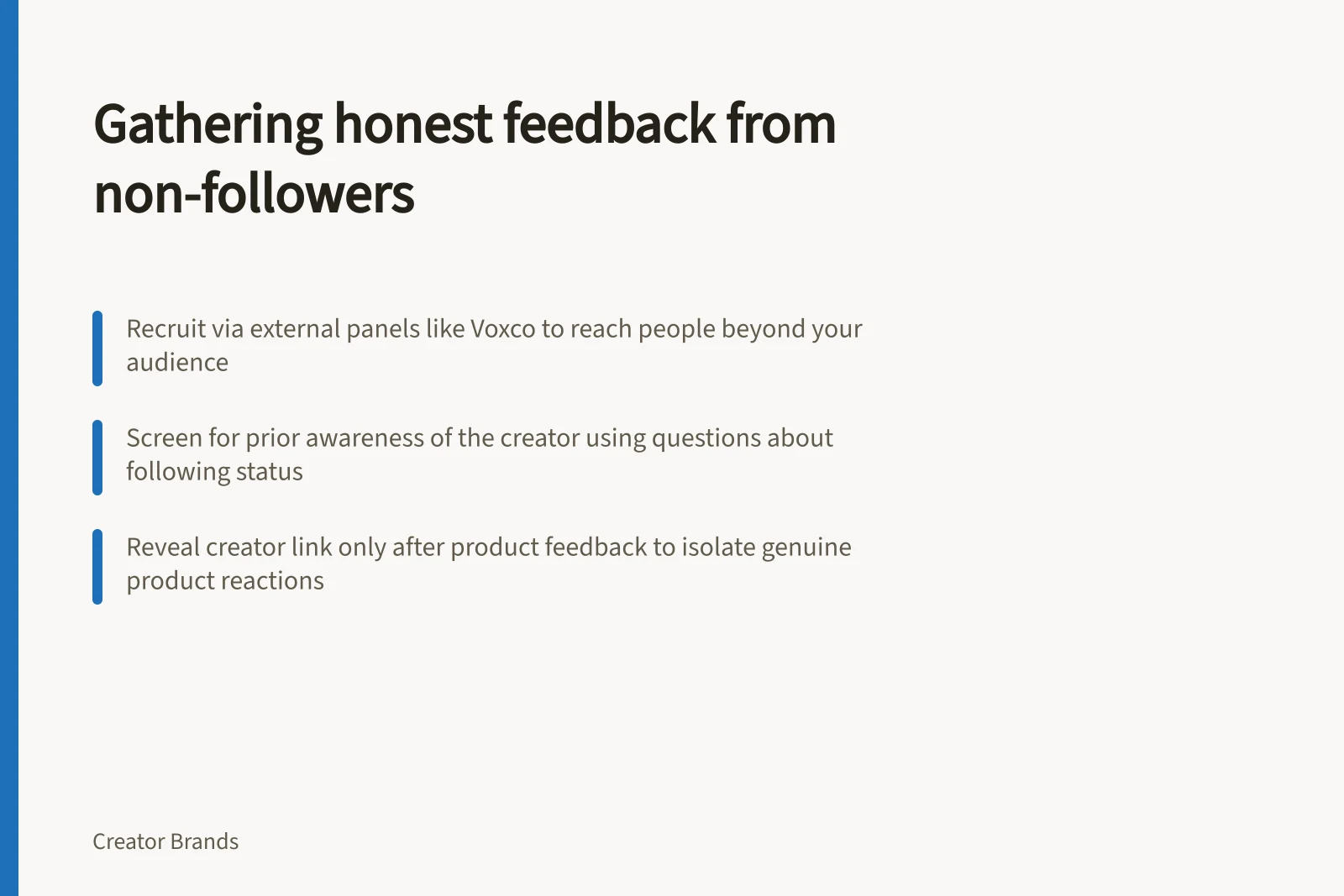
Recruit people with relevant product-category experience through channels outside the creator’s own audience. Screen for whether they previously followed the creator, then ask about the product before revealing its connection to the creator. An independent recruitment channel alone does not establish non-follower status.
Set the recruitment rule first
Describe the intended buyer’s situation: what they use now, the problem they face and any practical requirement for using the product. Recruit through a suitable research panel, a community that permits invitations, or an appropriate in-person setting. A research panel such as Voxco can help you reach consumers beyond your own database.
Use a short screener to check category relevance and prior awareness. Ask, “Do you use [category] now?” and “Before today, had you heard of [creator] or [brand]?” Then ask, “Do you follow [creator] now, or have you followed them in the past?”
Treat following status as self-reported; do not infer it from the recruitment channel. Keep people who are unsure about their prior relationship to the creator in a separate group. Record where each person came from and why they qualified, and do not describe a convenient or volunteer sample as representative of all potential customers.
Show the same offer and ask neutral questions
Prepare the same plain description for each participant, including what the product is, what is included, its limits, price and relevant terms. If a usable sample exists, present it consistently. Ask what the person thinks the product does before supplying an explanation.
- What do you use for this purpose now?
- What would you choose if this product were unavailable?
- Which detail would you need clarified before deciding?
- What would make you reject this offer?
Ask about current behaviour before hypothetical future purchases. Stated purchase intention is feedback, not an order. If the item is a prototype, identify it as such and keep comments about that version separate from claims about a finished product.
Record objections and the creator effect
Take written notes during the interview and add any missing context afterwards. Use a participant code in the notes, keep contact details separate from feedback, and remove identifying details from working summaries where they are not needed.
Keep the recruitment source, screener answer, material shown and main response together. Note whether an objection concerns the product, its explanation, price or availability. Preserve objections that point to a serious problem even if other participants are enthusiastic.
After the product questions, reveal the creator association if it is part of the intended offer. Ask whether it changes trust, interest or expectations. This can help distinguish a product response from a response to the creator, but an informal interview is not a controlled experiment.
Small interviews and non-random surveys are useful for finding problems and questions to investigate. They cannot establish the proportion of Australians who would buy.
For privacy handling, use OAIC guidance on the Australian Privacy Principles (APPs). Under APP 3, an APP entity may collect personal information only where it is reasonably necessary for its functions or activities, using lawful and fair means and collecting it from the person concerned unless that is unreasonable or impracticable; sensitive information has additional consent requirements.
Under APP 5, an APP entity must take reasonable steps to notify people about collection or ensure they know about it, before or at collection where practicable. Explain the collector’s identity and contact details, the purpose, whether collection is required or authorised by law, the consequences of not collecting, usual disclosures, the APP Privacy Policy and likely overseas recipients, including countries where practicable.
Keep any invitation to receive marketing separate from participation in research.
Key Privacy Requirements under Australian Privacy Principles (APPs)
- APP 3 – Collection of Personal InformationMust be reasonably necessary, collected lawfully and fairly, directly from the individual unless impracticable
- APP 5 – Notification of CollectionMust notify participants of identity, purpose, consequences of non-collection, disclosures, and privacy policy