Brand Positioning
Part of Creator brand positioning
Defining buyers beyond the existing follower base
Describe prospective buyers by their product need, alternatives and constraints, then refine the profile with appropriately bounded research.
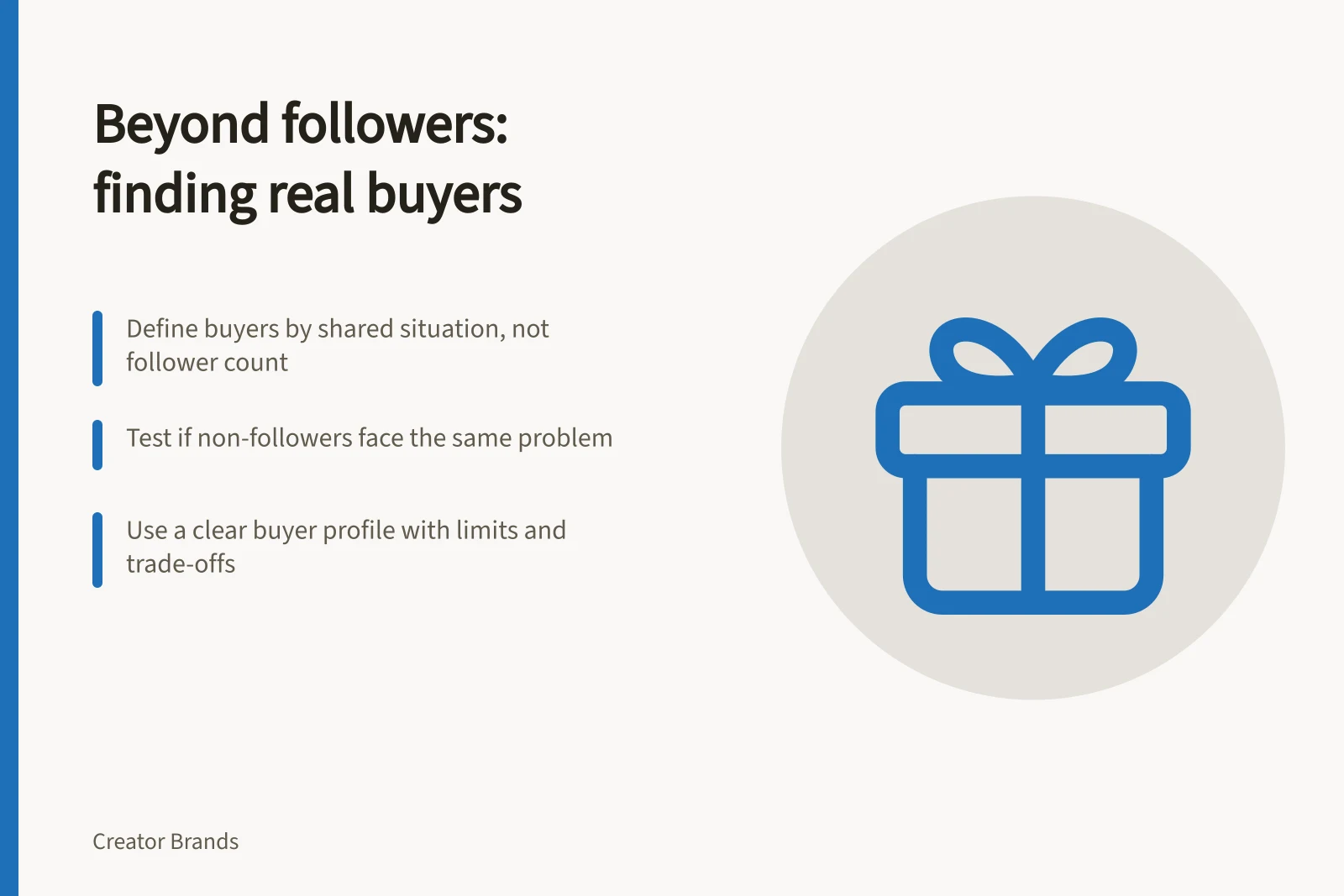
Define the prospective buyer by the situation that makes the product useful, then investigate whether people outside the creator’s following share that situation. A follower count records accounts following a channel; it does not tell you who will see or buy an item.
Describe the buying decision
Begin with a concrete trigger: a task, frustration or change in circumstances. Record what the person uses now, what they might compare with the proposed product and which trade-off could make them switch. Add constraints such as space, budget or frequency of use when they affect that decision.
“People who follow the creator” describes a channel audience, but does little to explain product fit. A more useful hypothetical profile is “people who share a compact desk and need their daily tools to be easy to clear away”. It names a situation to investigate without assuming who follows the creator.
Keep product need and creator familiarity separate
| People to consider | Question for positioning | What their response cannot establish |
|---|---|---|
| Followers with the relevant need | What questions or objections do they have about the item? | That all followers need or will buy it |
| People with the need who did not come through the creator’s channel | Can they understand and consider the offer on its own terms? | A market-wide purchase rate from a small sample |
| People outside the intended use | Which features or conditions make the item unsuitable? | A reason to broaden the promise to everyone |
These are working groups, not fixed or mutually exclusive customer segments. Someone may discover the product before following the creator. Ask about prior familiarity when it matters; the route by which someone was recruited does not prove whether they are a follower.
Follower Base vs. Prospective Buyer: What Really Matters
- Follower CountTracks accounts following a creator’s channel
- Prospective Buyer ProfilePeople in a specific situation needing a solution (e.g., compact desk users needing easy-to-clear tools)
Choose a first buyer and a clear limit
List a few plausible use situations. For each, write the present alternative, the proposed advantage and the strongest objection. Choose an initial buyer whose problem the product can plausibly address and whose decision you can explain. Name a use the product is unsuitable for, too.
A hypothetical small desk organiser might suit someone moving between shared workspaces but be unsuitable for storing large equipment. Check any such distinction against the actual product and intended users. It says nothing by itself about whether either group wants to buy.
A narrower situation can make the offer easier to explain. Additional buyers can be considered when the team has better evidence about the product and its users.
Revise the profile with research
Australian business guidance suggests researching your customers — including who they are and what they want — as well as your products or services and your competitors. Ask people in the chosen situation what they use now and what would make them reject the proposed offer. Include participants who did not arrive through the creator’s channel, and record how they were found.
Show participants the same plain product description and relevant terms. Note whether each response concerns the underlying need, the item or its explanation. A few conversations may reveal a mistaken buyer assumption, but they cannot estimate demand across Australia. Do not describe an unperformed exercise as validation.
Write a working buyer statement: This product is for [person in a use situation] choosing between [realistic alternatives] who values [specific distinction] and accepts [relevant limit]. Revisit it when product details or credible customer evidence change. Measuring who becomes a customer is a separate task.
Key Research Principles for Australian Businesses
- Research Focus
- Customers, products, and competitors
- Include Non-Followers
- Essential for unbiased insight into product fit
- Use Plain Descriptions
- Avoid influencer bias; test on standalone terms
- Avoid Demand Estimation
- Small conversations ≠ market-wide purchase rate