Brand Positioning
Creator brand identity
A creator can bring the first audience to a product, but the product still needs to explain itself to someone who has never seen a post. Brand identity works when …
undefined
Creator brand identity is the set of cues that tell people what a creator stands for and who their work serves. For a creator-led product, keep that identity distinct from the product’s own name, purpose and reasons to buy: the creator can attract attention, but a new customer should understand the offer without having seen a post.
Define the creator’s identity separately
Define the creator brand in one sentence about expertise, point of view and audience served. Define the product separately in one sentence about what it is and why a customer might choose it. If a product claim only makes sense to followers who know the creator’s story, rewrite it for someone encountering the offer for the first time.
Narrow the focus by naming the audience and the creator’s niche. Ask what the creator or their work offers that is distinctive, what audience need it serves, and what experience supports that difference. These answers give the identity a clear point of view instead of a broad list of topics.
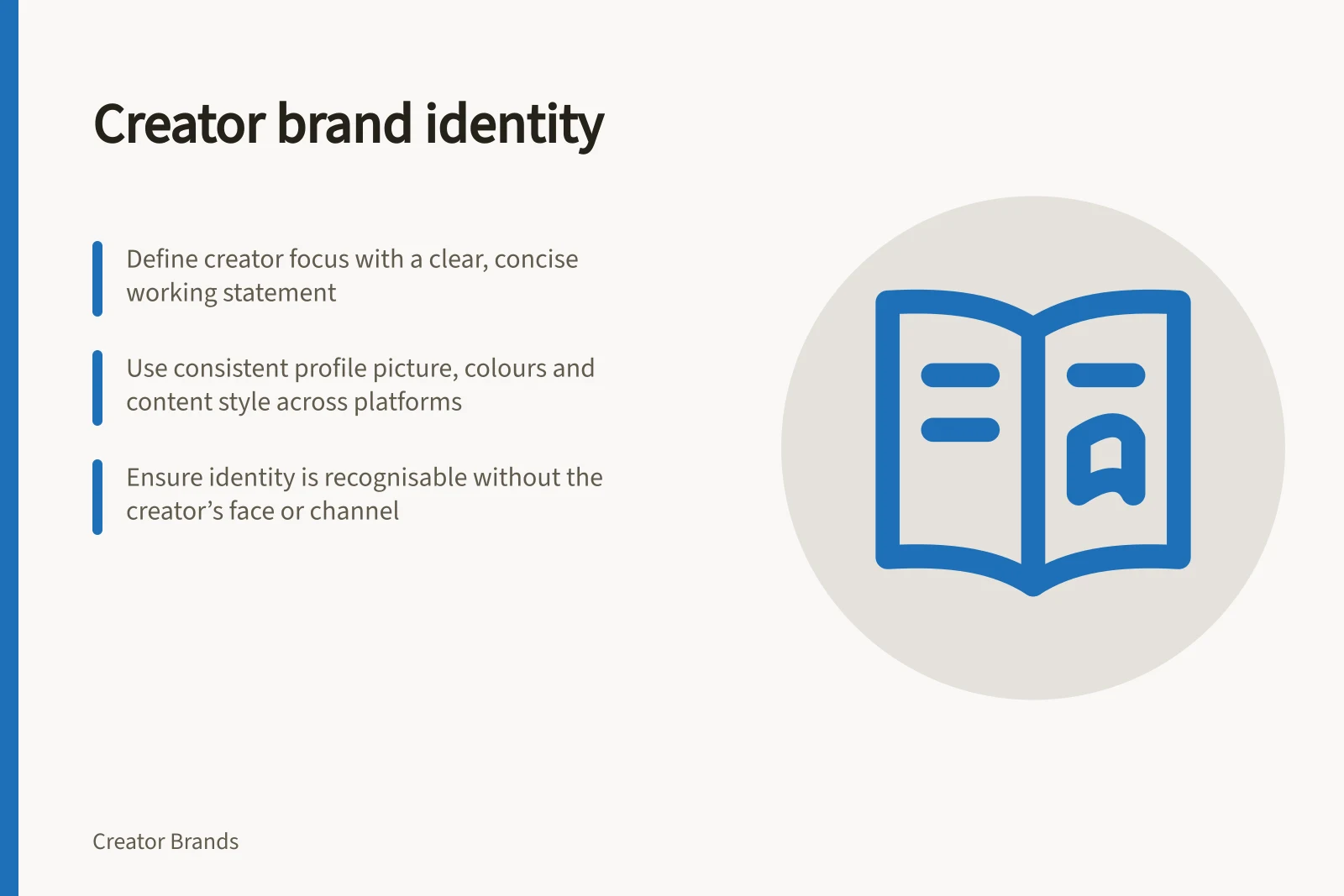
Turn those answers into a short working statement: “I help [audience] [achieve or understand something] through [expertise or approach]; I believe [value].” Fill in each part using the creator’s real work and views. Use the statement to guide the bio and content, rather than trying to tell the creator’s whole story everywhere.
Decide what the identity must communicate
Test the identity message with someone unfamiliar with the creator. Ask them to read the statement without seeing the creator’s face or personal channel, then explain what the creator is known for and who the work serves. If either answer is unclear, refine the audience, niche or point of view before applying the identity across profiles and content.
Keep the creator’s identity separate from the product’s explanation on a product page and package. State the product’s name, what it is and why a customer might choose it in plain language; creator cues can signal the connection, but should not replace those details. Check whether someone new to the offer can explain both who the creator is and what the product does.
Make the identity recognisable
Options include Twitter, LinkedIn, YouTube, Facebook, Instagram and TikTok (Morningstar). List where the intended audience already engages, then choose the platform whose formats and publishing demands the creator can sustain. Build for that channel before extending elsewhere, rather than trying to maintain a presence everywhere.
Use the profile bio to state the creator’s focus and core values in plain language. Pallyy’s YouTube Channel Description Generator is a drafting option; its guidance recommends identifying who the channel serves and what they gain, adding an upload cadence and a line of proof, and weaving in relevant keywords and links to the creator’s site or social accounts (Pallyy).
For Instagram, keep the profile picture relevant and instantly recognisable, and make posts recognisable as the creator’s work (Open Colleges Australia). Choose a repeatable set of colours, image treatments and content types, then check whether the profile and posts still look and feel connected to the same identity.
Carry the creator identity into product packaging
On packaging, give the product name, use and claims their own plain-language explanation. Use creator cues such as imagery, colour or voice to signal the connection, not as a substitute for explaining what the product is. Ask someone unfamiliar with the creator to look at the pack and explain the offer; revise it if the creator is clear but the product is not.
IP Australia recommends Australian Trade Mark Search (ATMS) for checking a new idea. It can search by text or image and compare against existing trade mark logos (IP Australia).
IP Australia’s TM Checker is a free AI-assisted check of common problems and provides feedback about the likely success of a registered trade mark application (IP Australia). Record potential conflicts and revisit the proposed name or mark before using it.
Key Australian Resources for Protecting Your Creator Brand
- Trade Mark Search
- IP Australia’s ATMS
- AI-Assisted Trade Mark Check
- TM Checker – free tool for feedback on registration success
- Product Labelling Guidelines
- Business.gov.au – labelling your products under Australian law
- Copyright Protection
- Business.gov.au – protecting your brand idea or creation
- Contract Preparation
- Business.gov.au – preparing contracts with contractors
Express the identity through content
Choose a small set of recurring content themes that demonstrate the creator’s niche and expertise. For each theme, identify a question the audience has and a useful way to answer it, such as a how-to guide, explainer or checklist. Give each format a clear connection to the creator’s working identity statement.
Choose topics the creator can speak about from direct experience. Before publishing, check that the point of view and examples sound like the creator rather than a borrowed brand voice. A genuine voice is more likely to hold attention than content that feels false or inorganic.
Review the bio, recent posts and product explanation together. Check that the bio sets expectations the content fulfils, that the content looks and feels connected to the creator, and that the product still makes sense to someone who has not seen the creator’s posts. Adjust whichever element breaks that connection.
In this guide
- Choosing a product name that can stand apart from the creatorA creator’s audience may recognise a personal name instantly. A first-time shopper may not. A product name should tell both groups what to look for and remain …
- Designing packaging around accurate product informationPackaging must help a buyer understand the product before the creator’s promotion reaches them. Start with the category, quantity, intended use and any instructions …
- Keeping creator imagery from overwhelming the productA familiar face can draw attention to a launch. It should not be the only clue to what is being sold. Test the design with someone who does not follow the creator …
- Checking rights to names and design assets before launchA launch can be delayed by a name conflict or by artwork the business cannot use on packaging. Review rights while the brand is still a draft, before ordering stock or advertising.