Brand Positioning
Part of Building a product brand around a creator
Creator-owned brands versus sponsored collaborations
Compare creator ownership and sponsorship by product control, operating work, income, asset rights and the message buyers see.
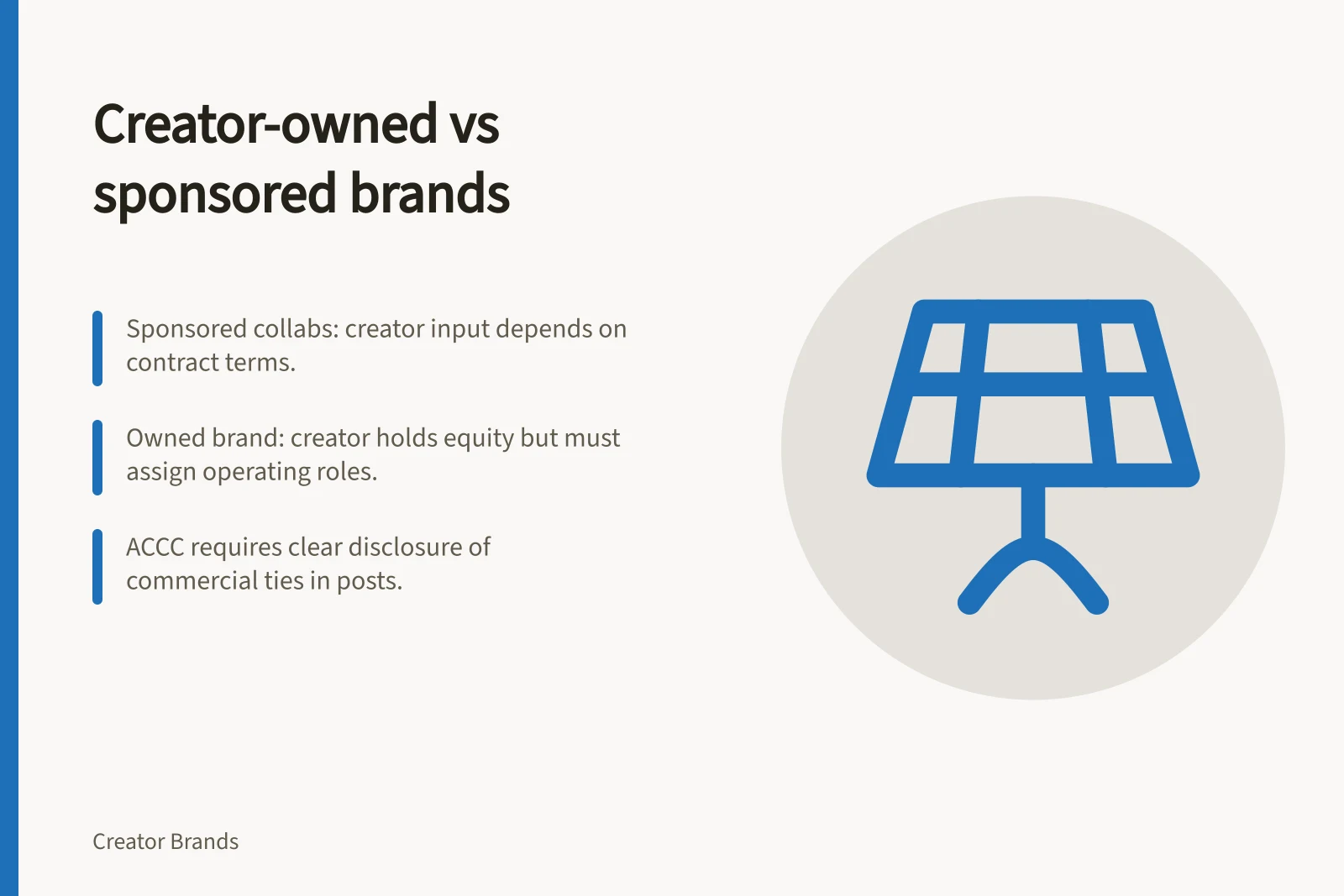
The choice hinges on who controls and runs the product business. In a sponsored collaboration, a creator promotes an offer under an agreement with another business.
In a creator-owned brand, the creator holds an ownership interest in the business or relevant assets. They still need an operator and clear agreements to turn that interest into a working product company. Campaign labels do not settle those rights; the actual arrangement does.
Compare the work behind each model
| Decision | Sponsored collaboration | Creator-owned brand |
|---|---|---|
| Product decisions | Usually led by the sponsoring business; the creator’s input depends on the agreement. | The owner or agreed management team can set the product direction, subject to partner rights. |
| Income | A negotiated fee, commission or other agreed consideration. | Depends on the creator’s ownership and payment terms; profit distributions, salary or royalties are possible, but none is assured. |
| Operating work | Usually performed by the product business, with creator duties defined by contract. | Must be assigned across product, supply, selling and service roles. |
| Control of name and content | Use is limited by the agreed rights and approval terms. | Ownership and permitted use still need to be established asset by asset. |
| Duration | The deal has the term and exit rights the parties negotiate. | The business may continue beyond one campaign, provided its rights and operations allow it. |
A collaboration may give a creator substantial design influence. An “owned” brand may give them little day-to-day control. Equity in a company, ownership of a trade mark and permission to use someone’s likeness are different matters.
Choose according to the commitment
A sponsorship can suit a creator who wants to test a category or use their expertise in a defined campaign without taking on the full work of a product company.
Ask what they may say about the item, what version they will receive, how their contribution will be approved and how payment relates to the content or sales.
Ownership may suit a creator who wants a continuing say in the product and is prepared to build or fund the team that will make, sell and support it.
Any financial upside depends on the business’s costs, results and agreed payment terms.
It is not a guarantee of higher earnings than a sponsorship. Ask who carries stock and development costs, who can approve a change, and who answers customers when the creator is unavailable.
A joint venture, licence or limited product collaboration may sit between the two. If several parties contribute a name, design, audience access or production capability, specify which contribution is owned, which is merely permitted for use and when that permission ends.
Key considerations before choosing a model
- Sponsorship suits creators who want to:Test a category or use expertise in a defined campaign without full product company responsibilities.
- Ownership suits creators who are ready to:Build or fund a team to make, sell and support the product with ongoing involvement.
- Financial upside is not guaranteed in either model — ask:Who carries stock and development costs? Who approves changes? Who handles customer queries when unavailable?
Put the commercial relationship where buyers can see it
The ACCC gives general guidance on avoiding false or misleading claims in social media advertising. It can require businesses to back up claims they make on social media.
Ownership can also affect the impression a post creates. Avoid presenting a claim as independent if that would mislead buyers about the creator’s connection to the business. Product claims and descriptions must not be false or misleading in either model.
Before signing, review product and content approvals, compensation, use of names and images, relevant IP, term, exit, outstanding customer commitments and who may correct an inaccurate post. Put the parties’ work, payment and IP ownership or use arrangements in a written contract before work starts.
Essential contract terms to review before signing
- Product and content approvalsClarify who approves final versions and what standards apply.
- Compensation structureDefine payment type (fee, commission, royalty) and timing.
- Use of names and imagesConfirm ownership and permitted usage rights for both parties.
- Intellectual property (IP)Specify ownership of trademarks, designs, content and digital assets.
- Term, exit and obligationsAgree on duration, termination conditions and outstanding commitments.
- Correction of inaccurate postsDefine responsibility for correcting misleading claims after publication.