Brand Positioning
Part of Creator brand retail expansion
Explaining the brand to shoppers unfamiliar with the creator
Make a creator product understandable on a shelf with clear product copy, accurate claims and a useful role for the creator story.
undefined
On a retail shelf, explain the product before the creator behind it. Shoppers should know what it is, whether it suits them and what they will receive, even without recognising the creator’s name or face. The creator story can then add context.
Write for the moment of discovery
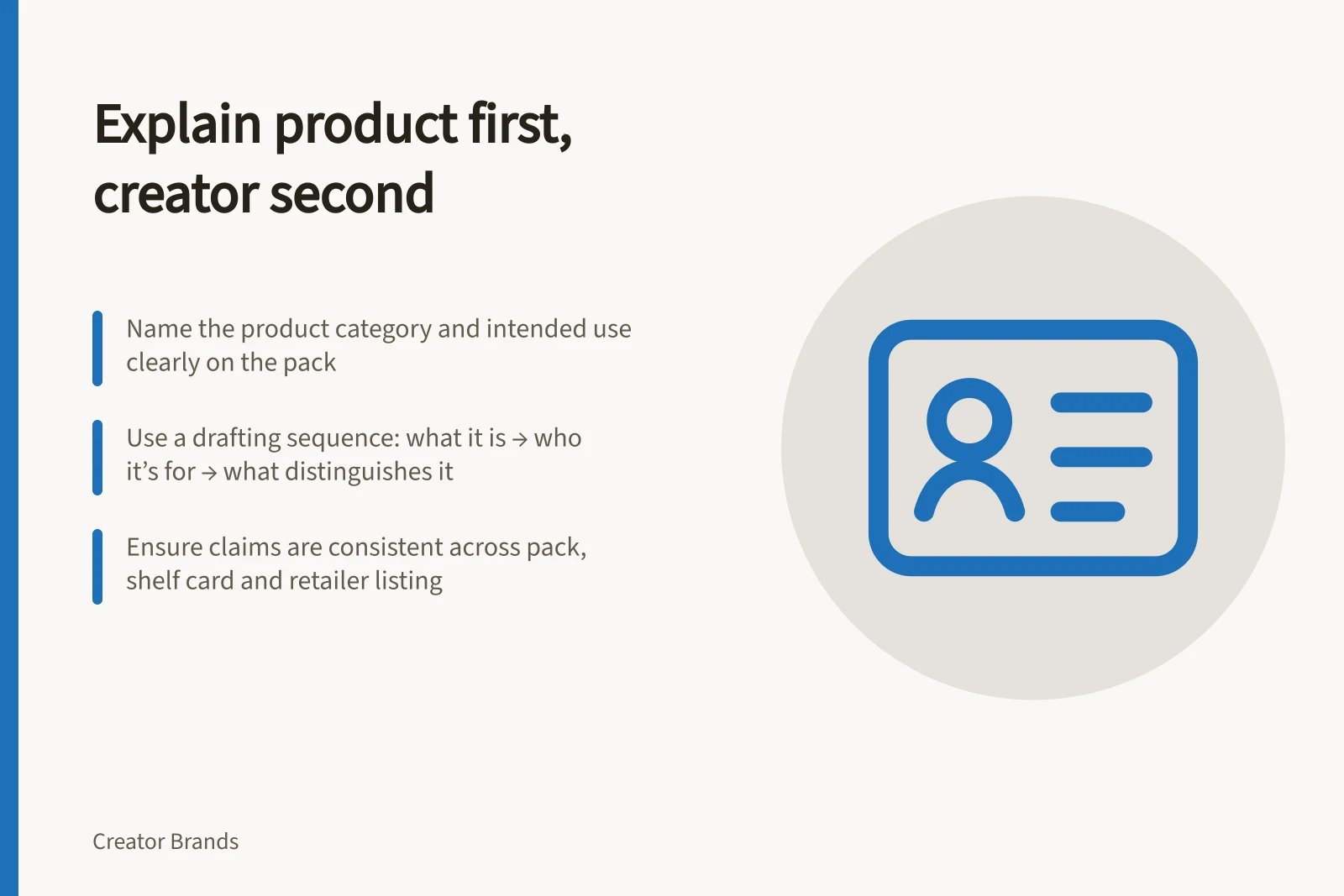
Look at the front of the pack as a new shopper would. Name the product category and intended use. Add a meaningful distinction you can substantiate, and make the variant and quantity easy to find. A portrait or signature may appeal to a follower, but it should not crowd out essential product information.
A useful drafting sequence is product category, intended audience, verifiable distinction, use or choice guidance, then creator attribution. This is a way to write the explanation, not a prescribed pack layout. Australian category rules determine what the finished pack must show.
Try: “A [product category] for [intended use], with [verified distinction]. Use [directions] to [purpose].” Replace each bracket with accurate product information. The Australian Consumer Law (ACL) regulates country-of-origin claims and other origin-labelling issues (ACCC). If you sell or supply food for sale to consumers in stores, markets, online or from vending machines, you are likely required to comply with the Country of Origin Food Labelling Information Standard 2016 (ACCC).
Drafting clear product copy for retail shelves
- Product categoryA [product category] for [intended use]
- Verifiable distinctionwith [verified distinction]
- Use or choice guidanceUse [directions] to [purpose]
- Creator attributionby [creator name] – only if contribution is accurate
Give each retail surface a purpose
The pack should identify the product and carry information needed at the point of choice. Where the retailer permits it, a shelf card might explain how two variants differ. A retailer listing can give more detail about contents, dimensions or use. A longer brand story belongs where a shopper chooses to read it.
A shelf-card example is: “Choose [variant A] for [use or feature]; choose [variant B] for [different use or feature].” Use only a contrast that is true of the products.
Amazon Vendors are responsible for supplying product photography and content, including comparison charts; Amazon Sellers control their listings subject to Amazon’s restrictions (MerchantSpring). Coles Supplier Central and Woolworths Partner Hub are routes to apply to stock those retailers (Syncio). Chemist Warehouse’s supplier compliance guidelines cover product barcoding and labelling (CW Supplier Compliance Guidelines).
Keep claims consistent: if a shelf card promises a result that the pack qualifies, the overall impression may mislead. The ACCC can require businesses to back up claims about products or services (ACCC). The Australian Consumer Law regulates country-of-origin claims, and the ACCC may call on a business to substantiate an origin representation (ACCC). Check the finished product and exact wording before making origin, performance or sustainability claims.
For food products, the Food Standards Code sets out labelling matters including use-by and best-before dates, ingredients, food additives, allergens, nutrition information, health advice and claims, and the supplier’s name and address. business.gov.au directs readers to Food Standards Australia New Zealand (FSANZ) for food-labelling rules (business.gov.au).
Variant comparison on a shelf card
- Variant A
- Choose for [specific use or feature]
- Variant B
- Choose for [different use or feature]
Use the creator connection accurately
Describe what the creator actually contributed, such as a problem they identified or a design choice they made. Do not imply that they manufactured or personally tested a version unless that is true. If their identity does not explain a product decision, brief attribution is enough.
Imagery also shapes expectations. Show included items accurately, and avoid a styled photograph that implies an accessory comes in the pack when it does not. Give retail staff a plain product description they can use without telling the creator’s backstory.
Check the message for clarity
Run a clarity check with people who do not follow the creator. Ask what the product is, which variant they would choose, what they expect to receive and what remains unclear. Record misunderstandings and revise the surface that caused them. This tests comprehension, not sales potential.
View the finished material at shelf distance and at the size of a retailer listing thumbnail. Make sure the product remains understandable in both settings.
Clarity check for shoppers unfamiliar with the creator
- What is the product?Tested with non-followers
- Which variant would they choose?Based on product description alone
- What do they expect to receive?Matches actual contents
- What remains unclear?Identified and revised