Launch Economics
Part of Creator brand retail expansion
Comparing retail margin with direct-store economics
Compare wholesale and direct-store contribution using consistent product costs, channel costs, expected credits and cash timing.
Compare what the brand keeps per fulfilled unit in each channel, then compare cash timing and the work required to earn it. A retailer's gross spread is not the brand's contribution. A higher direct-store selling price does not guarantee a better result after fulfilment and acquisition costs.
Put both channels on the same basis
Choose one product, one saleable unit and one reporting period. Treat GST consistently with the business's accounting.
For wholesale, use the price the retailer pays the brand, adjusted for expected credits and deductions. For direct sales, use the amount retained after discounts and expected refunds. Do not substitute the shelf price for the brand's wholesale receipt.
Define product cost consistently across channels, including the costs needed to make a saleable unit. Then add costs caused by each channel.
Wholesale may involve case freight, promotional allowances, account administration and damage credits. Direct orders may involve payment fees, pick and pack, delivery subsidies, customer support and paid acquisition. Keep shared overhead visible separately. Avoid counting returns both as reduced revenue and as a second identical cost.
A useful management measure is contribution per fulfilled unit = net channel revenue − product cost − channel-specific variable costs. It is not a statutory profit figure, and the result depends on the costs and expected credits included.
Walk through a hypothetical comparison
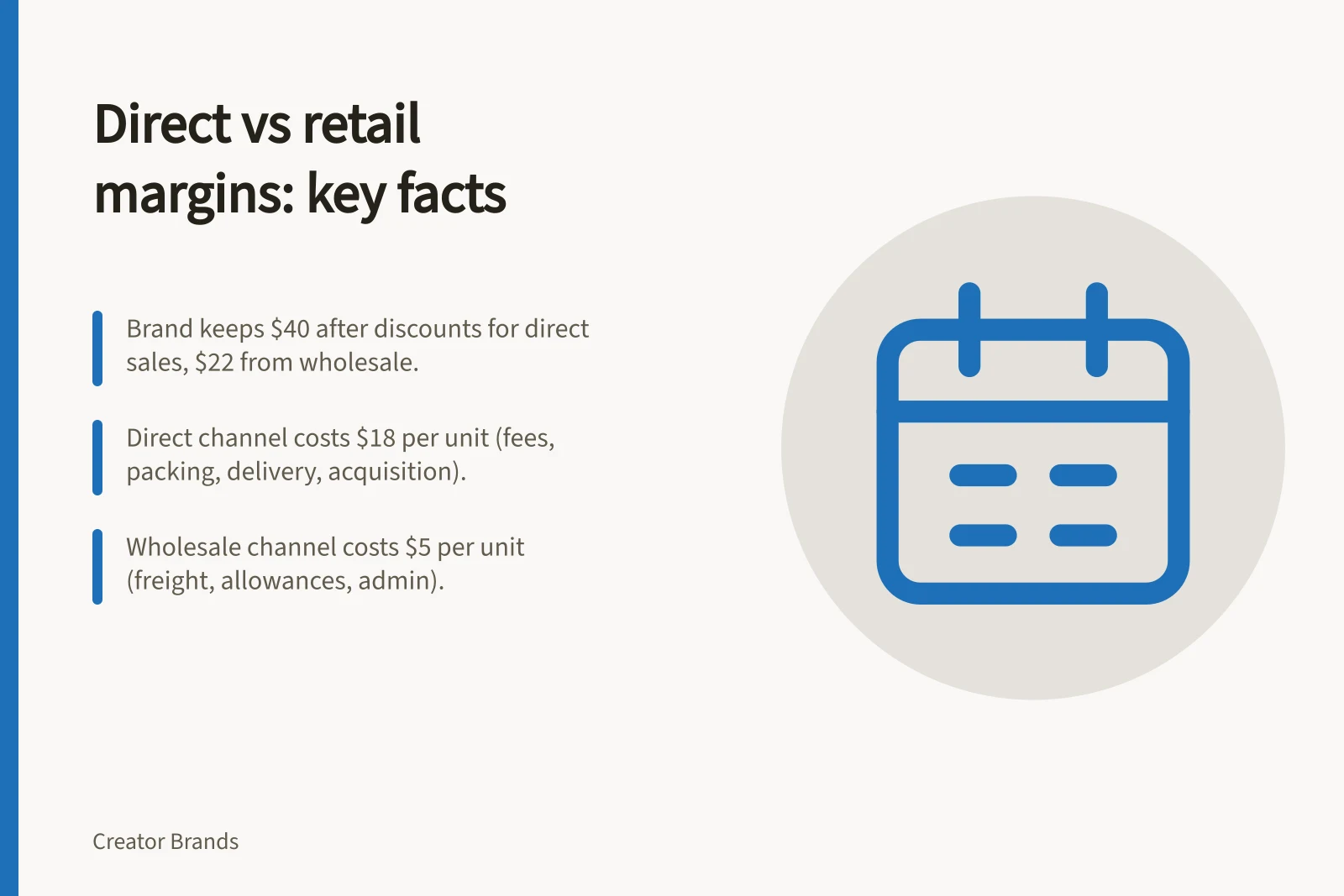
The figures below are invented teaching amounts for one fulfilled unit on the same tax basis. Assume the direct store retains $40 after discounts and expected refunds, while a retailer pays the brand a net $22. Product cost is $12 in either channel.
| Per fulfilled unit | Direct store | Wholesale retailer |
|---|---|---|
| Net brand revenue | $40 | $22 |
| Product cost | $12 | $12 |
| Channel-specific variable costs | $18 | $5 |
| Illustrative contribution | $10 | $5 |
The direct column's $18 could cover fees, packing, delivery support and acquisition. The wholesale column's $5 could cover case freight and agreed allowances. These amounts are not industry benchmarks or a forecast.
If the retailer then sells that unit for $40 on the same tax basis, the $18 difference between its sale price and $22 purchase price is a gross spread before the retailer's own costs. It is not brand revenue. The retailer may sell for a different price: Australian suppliers may recommend resale prices but generally cannot impose a minimum unless an ACCC exemption applies.
Test the terms that move the answer
Recalculate for the proposed order quantity, production payments, invoice timing and deductions. An opening order may require the brand to fund stock well before payment arrives. If stock is supplied on consignment, model ownership, sales reporting and payment triggers separately.
For direct sales, distinguish orders from existing customers from those requiring paid acquisition. Compare like with like: a direct bundle and a single retail unit have different costs and quantities. Use a per-unit basis before comparing their totals.
Set a contribution floor and cash exposure limit before accepting terms. A lower wholesale contribution may still be worthwhile if the account reaches suitable shoppers and repeat orders cover its service cost. Revisit the comparison with the agreed terms and observed results.