Brand Positioning
Part of Creator brand positioning
Writing a credible reason for a creator's product launch
Connect the creator’s real contribution to a product decision, and keep the launch story accurate about the item customers can buy.
A credible launch reason connects a problem the creator can honestly discuss with a product decision the team actually made. Explain why this item exists, what the creator contributed and what customers can expect. Commercial ambition can be part of that account; an invented personal revelation cannot.
Gather the facts before writing
Ask the creator and operator what prompted the idea, what the creator observed or experienced, which decisions they influenced, and who developed and will supply the saleable product. Record any changes between the initial idea, samples and the item customers receive.
Use briefs, design records or other working evidence where available. If the creator commented on one prototype, say that; do not turn it into years of testing or claim they made the finished item. If a partner handled technical work or production, describe the creator’s contribution without taking credit for the partner’s work.
Keep details that help a buyer understand this product. A long, accurate account of the creator’s career can still leave the reason for this launch unclear.
Key Facts to Verify Before Publishing a Creator Product Launch Story
- Creator’s actual involvement in designConfirmed via briefs and design records
- Who developed and supplies the productPartner manufacturer handled production
- Changes from prototype to final productDimensions and tool capacity adjusted post-testing
- No exaggerated claims made (e.g. ‘perfected’, ‘tested for years’)Only verified contributions stated
Show the link between problem and product
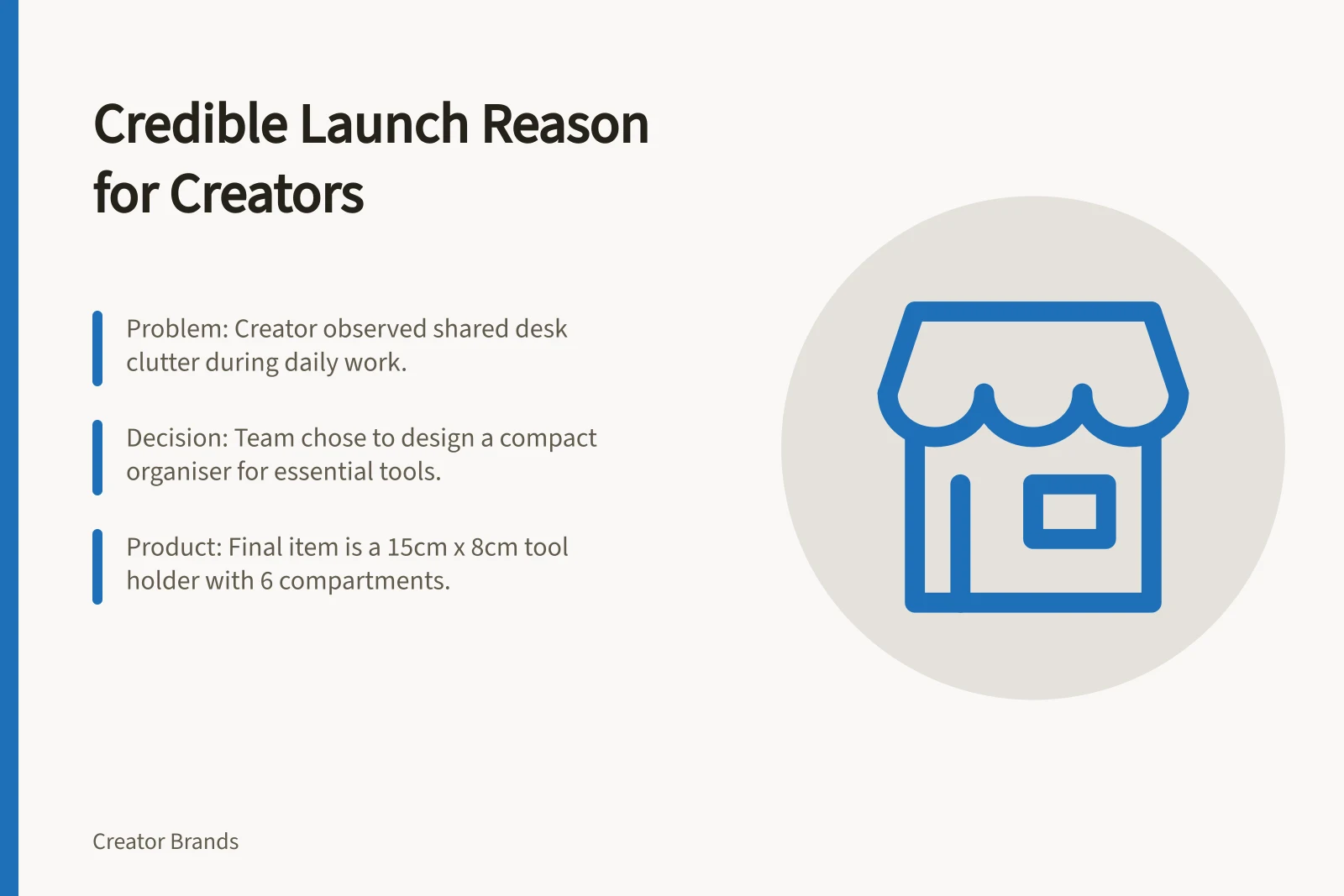
A short account can follow problem → decision → product. Name the situation the team chose to address, the decision it led to and how that decision appears in the item for sale. Put any limits that affect a buyer’s choice clearly in the product information.
Consider a hypothetical creator who often works at shared desks. Repeated difficulty clearing a workspace might lead them to brief a compact organiser designed around a small set of daily tools. Before publishing that story, the team would need to check the creator’s actual involvement and the finished item’s dimensions and contents. “I invented the perfect desk system for everyone” would add claims the example cannot support.
A creator and partner may simply have recognised an opportunity to serve a particular buyer. That can be stated plainly. The reason for launching need not be dramatic; it needs to be true and relevant to the offer.
Creating a Credible Creator Product Launch Story
- ProblemCreator experiences difficulty clearing shared workspace at co-working spaces
- DecisionDesign a compact, portable organiser for daily tools used in shared workspaces
Keep the story distinct from proof
An origin story explains a decision. It does not establish performance, quality, safety or demand. Review those claims separately. Claims about products or services, including claims made on social media, must not be false or misleading and must be able to be backed up.
Check verbs that may imply more than happened: “perfected”, “tested” and “designed by” can suggest particular work or evidence. Specify who did what.
ACCC Guidelines on Influencer & Business Advertising Claims
- False or misleading claims prohibited
- Under Australian Consumer Law (ACL)
- Social media promotions must be truthful
- Including influencer endorsements
- Claims must be substantiated
- Even if made verbally or visually
Adapt the account without changing its facts
A product page may need two sentences about the origin; a creator video may have room to show the problem and a design choice. Keep the underlying facts consistent. Make the product information clear to someone who skips the story.
Have someone outside the team read the draft and explain what they think the creator did, what benefit they expect and which product version is for sale. Use misunderstandings to revise the wording. This is a copy check, not a product test.
Keep the agreed facts and the applicable product version in a launch-story brief. If the item changes, update the story before using it to promote the offer.