Retail Expansion
Part of Audience and customer separation
Measuring customers acquired outside the creator's audience
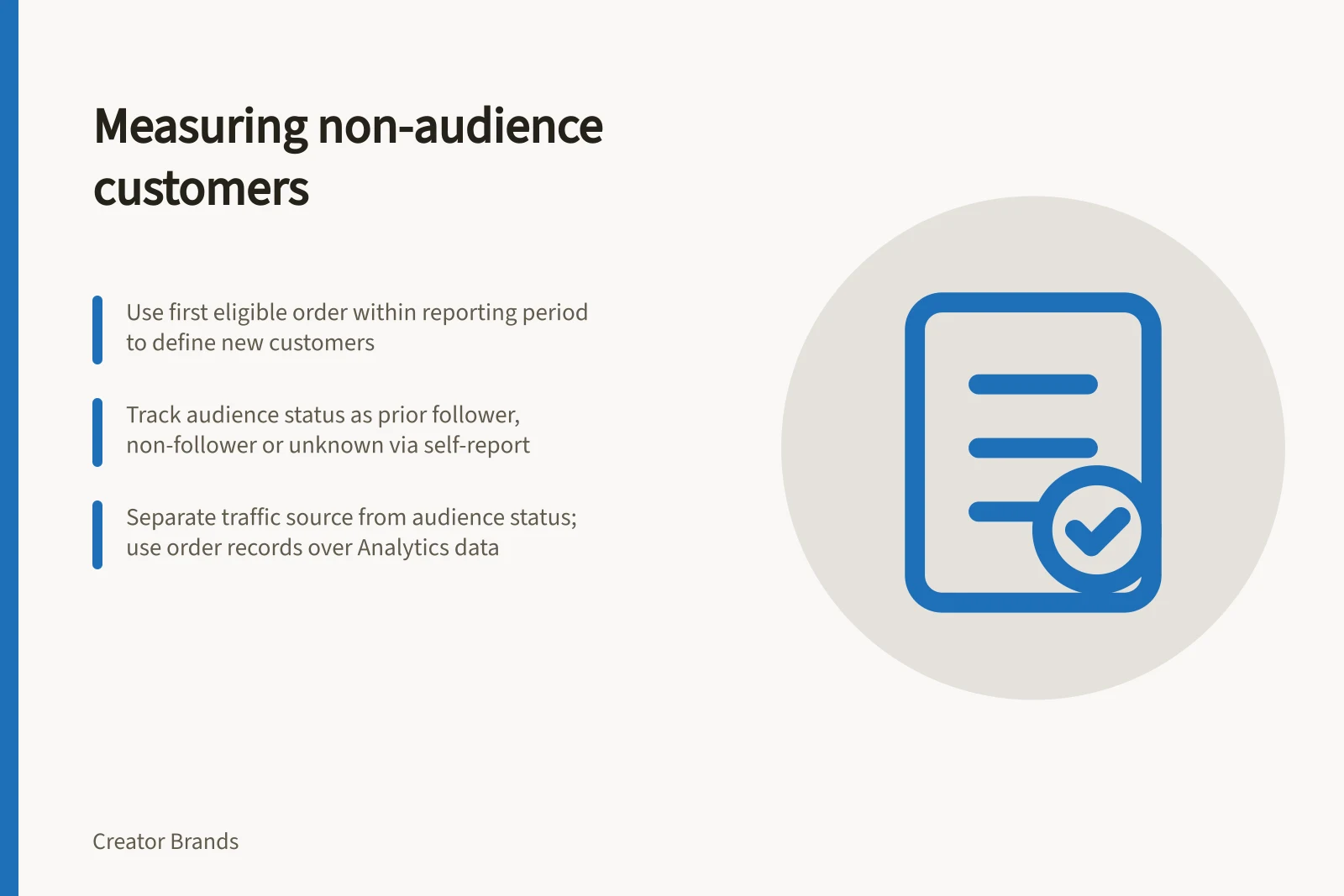
Define first-time customers, record prior follower status separately from traffic source and report self-reported non-followers with unknown cases.
To count customers outside the creator’s audience, you need a purchase record and information about whether each buyer already followed the creator.
Search, retail and direct traffic labels describe possible routes to an order. None proves the buyer’s audience status.
Define the customer count
Choose a reporting period and define an acquired customer as a person whose first eligible order with the brand falls within it. Check available order history before calling someone first-time; if earlier records are missing, state that limit.
Decide in advance how cancellations, refunds, duplicate customer records and retailer sales without buyer-level data affect the count. Apply the same rules across periods.
Use three audience-status groups: self-reported prior follower, self-reported prior non-follower and unknown. An optional question can ask whether the buyer followed the creator before first hearing about the product; keep that answer separate from marketing consent. Someone may misremember or leave the question blank, so do not describe self-reports as independently verified or assign unknown buyers to either group.
Separate route from relationship
Retain campaign tags and order referral fields where available, but store them separately from audience status. A follower may arrive through search; a non-follower may arrive through a creator post shared by someone else. Source fields also depend on the store’s tagging and measurement setup.
Traffic-source dimensions in Google Analytics are documented as having different scopes; consult the current documentation for how each field is scoped. Google Analytics also documents a (direct) / (none) traffic category and a reporting identity concept. These traffic-source and identity settings are separate from whether the buyer follows the creator, and they do not replace the order system’s customer records.
Reconcile and report
Begin with eligible first-time customers in the order system. If Analytics purchase events are available, compare transaction identifiers and totals with store orders. Investigate missing or duplicated events and account for refunds. Analytics can help explain recorded site activity; it does not replace the order record for deciding which purchases count.
Report the number of self-reported prior non-followers, self-reported prior followers and unknown cases, plus retailer customers for whom the brand has no buyer-level information. Show how many eligible customers answered the audience question.
If you calculate a percentage only among respondents, label it share of respondents and display the response coverage. Do not present that percentage as the share of all customers.
Compare periods only after noting changes in the question, tagging, retail coverage, order-history coverage and Analytics setup. An apparent change in outside-audience acquisition may reflect changed measurement. The defensible result is a count bounded by the available records, accompanied by the size of the unknown group.