Launch Economics
Part of Creator brand performance reviews
Comparing sales with profitable fulfilled orders
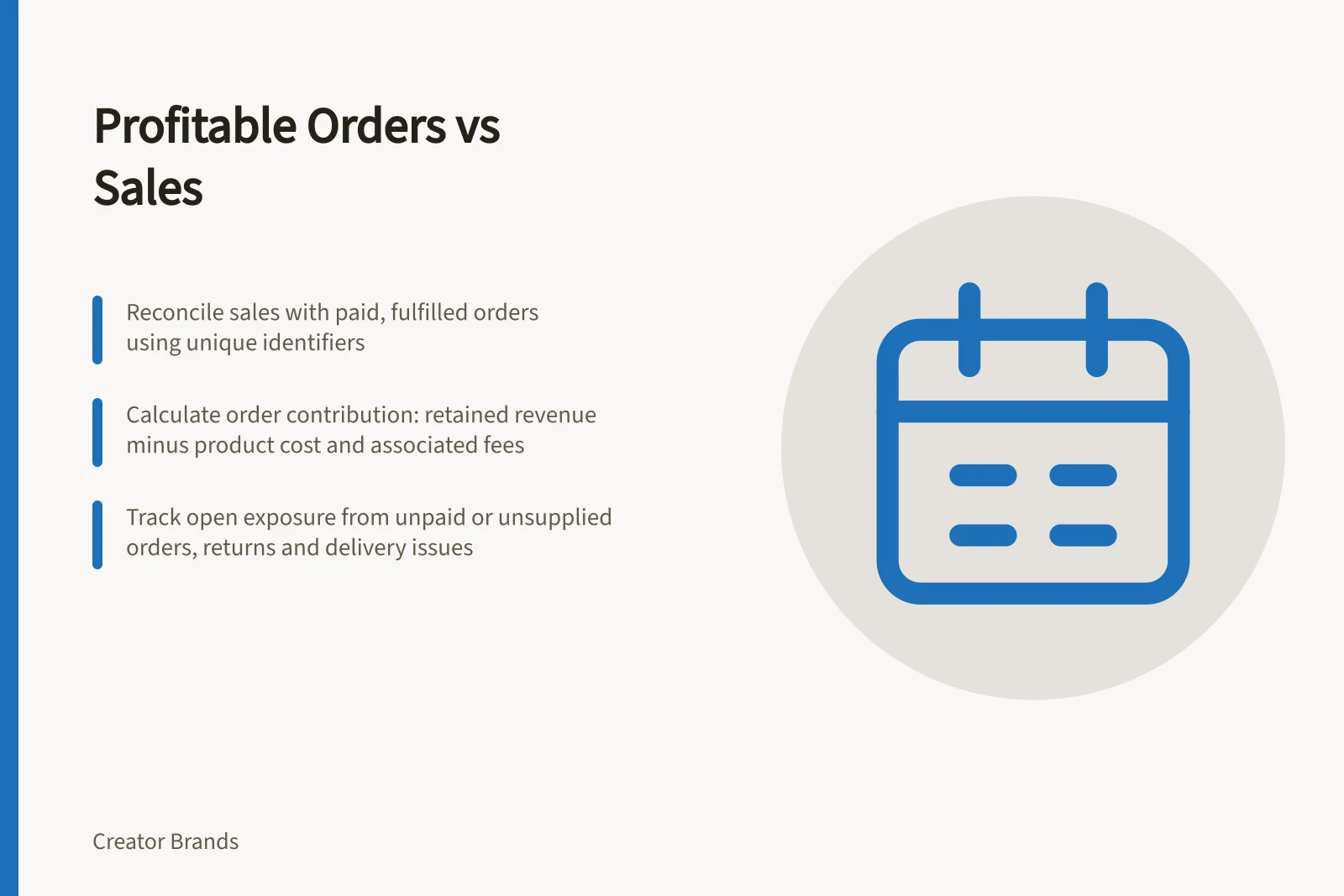
Reconcile sales reports with paid and supplied orders, then calculate retained contribution after refunds and order-associated costs.
Reconcile reported sales with orders that were paid and supplied. Then calculate what those orders contributed after associated costs. A positive contribution does not by itself mean the brand is profitable after fixed costs.
Reconcile orders at one cut-off
State the order period and review cut-off. Keep order identifiers so later payments, dispatches, refunds and returns can be traced without counting an order twice. Separate orders placed, paid but open, recorded as fulfilled, and cancelled or reversed. For partly supplied orders, work at item level where needed.
Check what fulfilment status means in the actual store. Keep payment, fulfilment, dispatch and delivery records distinct; a status label alone may not establish dispatch or customer receipt.
Sales reports may not show whether payment was received or whether an order remains open. Reconcile report totals against order, payment and transaction records before treating a sales total as retained revenue.
Sales vs. Profitable Fulfilled Orders: Key Differences
- Reported Sales (from Shopify)
- May include unpaid, cancelled or partially fulfilled orders; not guaranteed revenue
- Paid and Supplied Orders (Fulfilled)
- Only orders with confirmed payment and full dispatch; actual retained revenue
Calculate contribution from supplied orders
For the eligible supplied group, begin with revenue retained after discounts and applicable refunds, using a consistent GST basis. Include customer delivery charges where retained.
Subtract saleable product cost and costs attributable to those orders, such as payment fees, packaging, picking, delivery, routine support and identifiable acquisition cost. State how any shared or estimated cost was assigned.
Order contribution = retained order revenue − saleable product cost − included order-associated costs.
Keep development, software, scheduled staff time, creator payments and stock cash commitments in the wider review. This contribution figure is not whole-business net profit.
Contribution Calculation for Fulfilled Orders
- Retained Revenue (after discounts & refunds)
- Use consistent GST basis; include delivery charges if retained
- Subtractable Costs
- Product cost, payment fees, packaging, picking, delivery, support, acquisition cost
- Order Contribution
- Retained revenue − subtractable costs
Handle reversals and open exposure
A refund reduces retained revenue. Return freight, inspection or an unsaleable unit can add costs. Record each effect once; do not count the same refund as both lost revenue and a separate expense. Adjust only the affected items in a partial return.
Show contribution for orders supplied and retained so far alongside exposure from paid but unsupplied orders, unresolved returns and delivery problems. Revisit the result when later events change it. Treat unresolved delivery and return issues as open exposure, regardless of dispatch or platform status.
Find the next decision
Compare contribution by product, discount, delivery arrangement or acquisition route where records support it. Show both contribution per order and total contribution. Mark missing costs and small groups instead of assigning false precision.
Use the finding to revise an offer, fulfilment term, promotion or stock commitment, and record the definitions for the next review.