Launch Economics
Part of Creator brand performance reviews
Measuring repeat purchase beyond launch-day demand
Define a first-purchase cohort, allow a fair return window and interpret later orders alongside refunds, stock and offer changes.
Measure repeat purchase by tracking first-time buyers for a stated period in which another purchase was plausible. Count later eligible orders under one rule, and show how many buyers had the full opportunity to return. Launch-day demand cannot answer whether customers buy again.
Define the cohort and eligible orders
Use order records to group customers whose first eligible purchase fell within a named period. Decide how cancelled orders, full refunds, exchanges and duplicate customer records affect both first and later purchases. If older history is missing, call someone first-time in the available records.
Keep the first product, offer and purchase route with the cohort. A launch bundle, deep discount or stock outage may change a buyer’s next opportunity. Do not combine materially different offers without explaining the difference.
Defining a Repeat Purchase Cohort
- Identify first-time buyers within a defined periodUse order records to group customers whose initial purchase falls in a named timeframe
- Define eligible ordersInclude only valid purchases; exclude cancelled orders, full refunds, exchanges unless specified
- Preserve offer consistencyDo not mix cohorts with materially different offers (e.g., launch bundle vs. standard price)
- Handle missing historical dataTreat customers as first-time if no prior record exists in available data
Choose the opportunity window
Select an interval that fits the item before reading the result. A consumable might offer a plausible replenishment opportunity; a durable item may have no regular early replacement cycle. The chosen window is a management definition, not a universal retention standard.
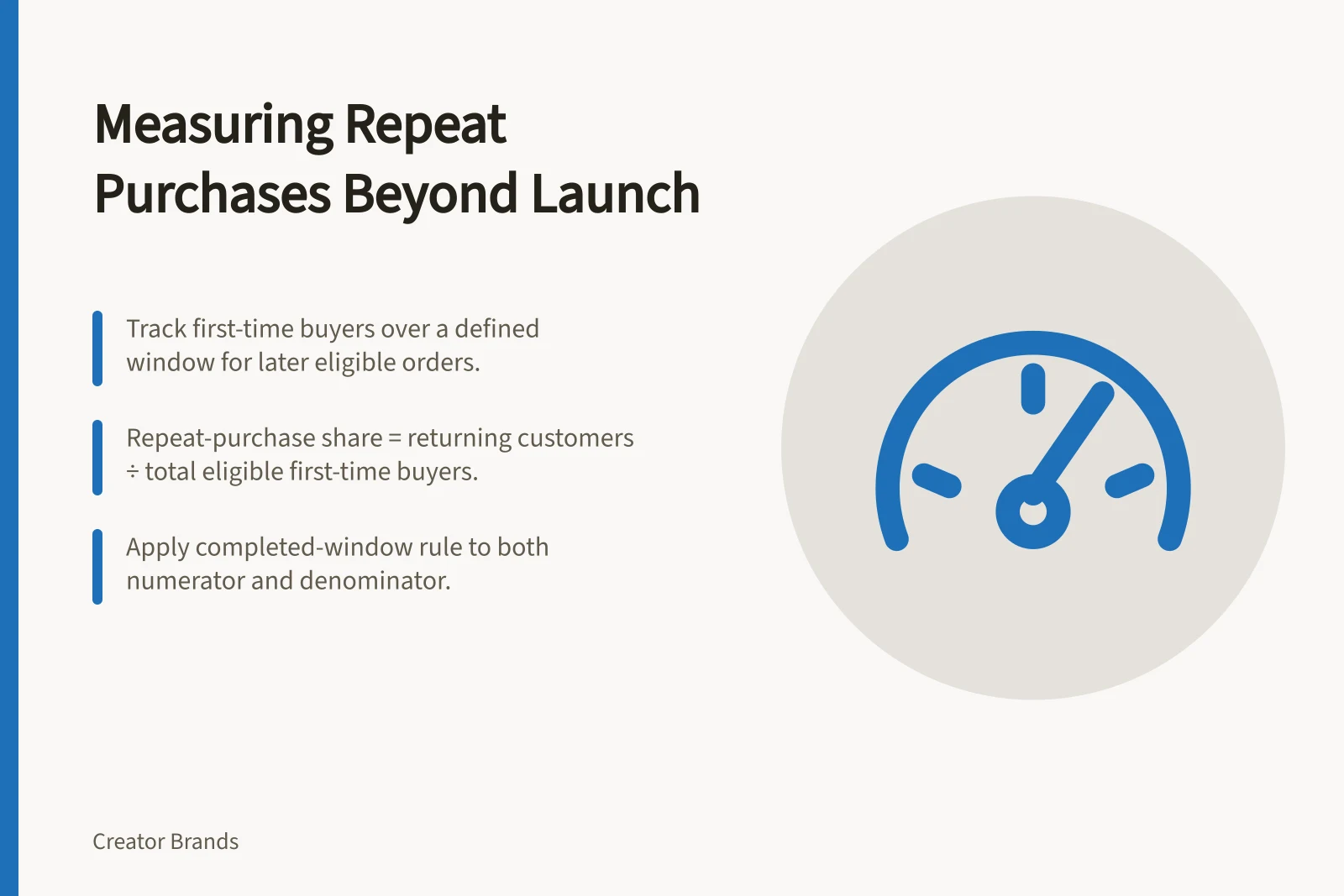
Repeat-purchase share = eligible customers with at least one later eligible order within the chosen interval ÷ eligible first-time customers who have completed that interval.
Apply the completed-window condition to both numerator and denominator. Count each returning customer once, even if they placed several orders. Show the cohort size and the numbers behind the percentage.
Report later order count or retained revenue separately if useful. Recent buyers whose window has not elapsed remain outside this completed comparison.
Shopify customer reports include customer cohort analysis as well as returning and one-time customer reports. The data in customer reports is based on the entire order history of the new customers in the report, not only orders placed during the selected timeframe; for example, a new customer from a month can still display as a repeat customer if they made a second purchase later.
A report's period and customer definitions can affect the percentage, so check them before use.
Key Repeat Purchase Metrics
- Repeat-Purchase Share FormulaEligible customers with at least one later eligible order ÷ Eligible first-time customers who completed the window
- Window RequirementBoth numerator and denominator must be based on completed opportunity windows
- Order Count RuleEach returning customer counted once, regardless of multiple orders
Pre-Reporting Checklist for Repeat Purchase Analysis
- Verify all customers have completed the windowExclude those whose window has not elapsed from the calculation
- Check for duplicate customer recordsEnsure accurate tracking of individual buyer behaviour
- Review report period and customer definitionsAlign with business logic to avoid misleading percentages
Read the second purchase in context
Ask whether the product remained available, what the customer bought next, and whether the later order was paid, supplied and retained after any refund. Compare cohorts at the same age. A launch cohort observed for six months cannot fairly be compared with last month’s cohort on a six-month return measure.
Note changes in product version, price, discounts and distribution. A second order at ordinary terms may answer a different question from one made under another deep discount. A small or self-selected customer survey may explain a particular experience but cannot account for every non-purchase.
Use the result to decide whether to investigate the product experience, improve availability or consider another stock commitment. Keep the conclusion tied to its cohort, window, eligibility rule and known gaps. Observed repeat buying is not a lifetime-value forecast or proof that the creator caused later orders.
Cohort Comparison: Launch-Day vs. Post-Launch Demand
- Launch-Day Demand
- High initial sales; does not indicate long-term repeat behaviour
- Post-Launch Repeat Purchases
- Reflects actual customer retention after initial hype fades
- Key Influences
- Product availability, pricing changes, discounting, version updates