Launch Economics
Creator brand performance reviews
Review repeat buying, supplied orders, contribution and creator-channel dependence before making the next product-brand commitment.
A creator brand performance review should answer what the business can commit to after launch attention fades. Read repeat buying, order completion, contribution and reliance on creator-controlled channels together. A sales spike alone cannot show whether the brand can supply customers and fund its next period of work.
Set the period and decision
Choose a period suited to the product's buying cycle. Record the product versions, prices, stock availability and campaigns before comparing periods. State the decision the review will inform, such as whether to reorder, change an offer or investigate a service problem.
Check data freshness before comparing
A report's displayed period and its data freshness are separate checks. Shopify sales reports are generally current to about a minute, while customer reports might omit store activity from the past 12 hours; its New vs returning customer report is an exception and is generally current to within a few seconds. Refresh reports where needed and record the data cut-off.
Read four views together
| View | Question | Limit |
|---|---|---|
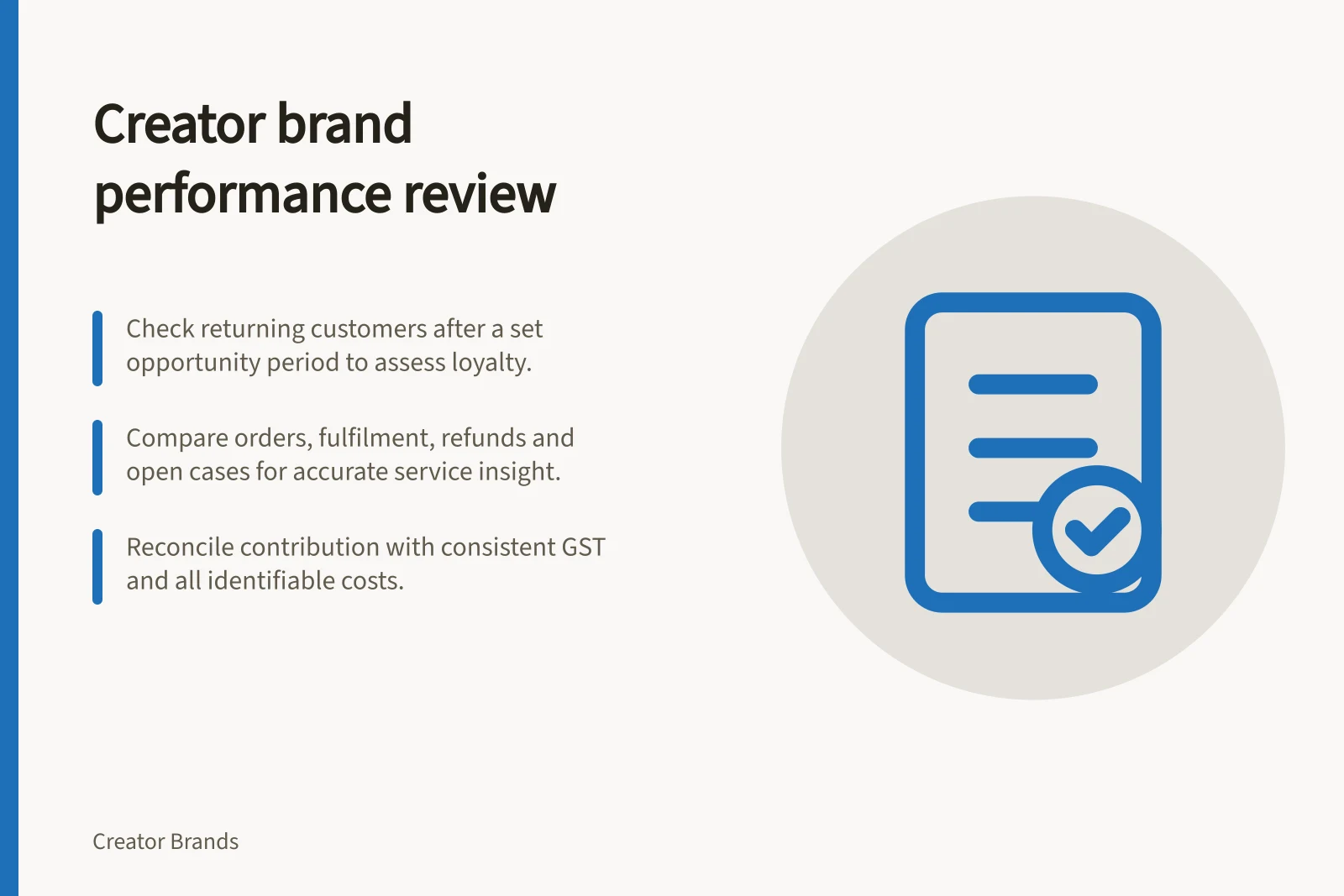
| Returning customers | Did eligible first-time buyers order again when another purchase was plausible? | Recent buyers may not have had enough time. |
| Orders and service | Which orders were paid, fulfilled, cancelled, refunded or still open? | An order placed is not necessarily an order supplied. |
| Contribution | What remains from supplied orders after their associated costs? | Contribution depends on the costs included and is not net profit. |
| Demand routes | How much recorded activity is associated with the creator’s channels? | Attribution does not establish what caused a purchase. |
Start with identifiable orders and their payment, fulfilment and return records. Use website and campaign reports to examine recorded routes, checking their definitions before comparing totals. For example, Shopify's gross sales can include pending, cancelled and unpaid orders. Its marketing-attributed sales cover a narrower, trackable set of activity.
Key Performance Indicators for Creator Brand Reviews
- Returning Customers
- Percentage of first-time buyers who reordered within a defined window
- Order Fulfilment Rate
- Paid and fulfilled orders / total paid orders
- Contribution Margin
- Retained revenue after product, payment, packing, delivery, support and acquisition costs (GST-inclusive)
- Creator-Channel Attribution
- Recorded sales linked to creator-controlled routes (e.g., social tags, affiliate links)
Translate platform metrics into review questions
Shopify's Marketing summary in the Growth section uses sessions, conversion rate, average order value and total sales. A session is a period of visitor activity in which each visit is less than 30 minutes apart, and conversion rate is the percentage of sessions that resulted in an order. These measures describe recorded store activity; they do not show whether orders were retained or contributed enough to support the business.
Check metric definitions before setting reports side by side. Shopify's sales-report average order value uses gross sales excluding adjustments, less discounts excluding adjustments, divided by orders. Its marketing summary describes average order value as gross sales less discounts, divided by total orders. Shopify total sales are net sales—gross sales less discounts and sales reversals—plus taxes and shipping, across sales channels.
Shopify Sales Report Metrics vs. Marketing Summary Metrics
- Average Order Value (Sales Report)Gross sales excluding adjustments, less discounts excluding adjustments, divided by orders
- Average Order Value (Marketing Summary)Gross sales less discounts, divided by total orders
- Total Sales (Sales Report)Net sales—gross sales less discounts and sales reversals—plus taxes and shipping, across sales channels
- Total Sales (Marketing Summary)Trackable attributed sales from Shopify and third-party campaigns sharing data
Interpret the results fairly
For repeat buying, group customers by their first eligible order and compare them only after a stated opportunity to return. Note stock outages, discounts and product changes. A durable item may have an irregular replacement cycle, so an early repeat rate can be a poor measure of its value.
For order contribution, reconcile retained revenue on a consistent GST basis with product, payment, packing, delivery, support and identifiable acquisition costs. Show unresolved orders and missing cost estimates. Keep fixed costs and stock payments visible in the wider business review. A platform gross-profit figure does not include every cost of serving an order.
For channel dependence, show recorded creator routes alongside other and unknown routes. Treat tracking labels as reported routing information, and note gaps in the records.
Pros and Cons of Relying on Creator-Driven Channel Attribution
- ProsIdentifies direct impact of influencer or creator content; supports ROI calculation for collaborations
- ConsAttribution gaps exist; does not prove causation; missing records may understate non-creator routes
Keep customer-report context attached
Shopify's New vs returning customer report classifies customers by whether their order history already includes an order. Its customer reports can draw on a new customer's entire order history, not only orders placed in the selected timeframe. A selected-month view may therefore include a customer whose second order came later; do not read the report period as proof that every repeat purchase happened within it.
Record the next commitment
Write down the period, data cut-off, definitions, material unknowns, chosen action, owner and review date. Size the next stock or spending commitment against what the records support.
Route a product or safety concern to the appropriate service and qualified assessment process promptly. Revisit the conclusion when later returns, costs or corrected records change it.
Combine signals before acting
If recorded sales rise while cancellations, refunds or open orders also rise, the order records qualify what the sales total means. If attributed sales rise but contribution weakens, the evidence supports checking the cost and order mix before increasing the commitment.
Traffic and order measures need the same care. Shopify reports online-store conversion as sessions resulting in an order, while its marketing summary attributes sales to online-store traffic from campaigns created in Shopify and third-party marketing sources that share data. That attributed total is not a count of all demand routes, so compare it with order records and the other and unknown routes already being reviewed.
A clear order or service issue can justify investigation even when demand looks strong. Where definitions, freshness or missing records could change the conclusion, state that uncertainty and defer a larger commitment until the relevant evidence is checked.
In this guide
- Measuring repeat purchase beyond launch-day demandDefine a first-purchase cohort, allow a fair return window and interpret later orders alongside refunds, stock and offer changes.
- Comparing sales with profitable fulfilled ordersReconcile sales reports with paid and supplied orders, then calculate retained contribution after refunds and order-associated costs.
- Reviewing dependence on one creator channelAssess creator-channel concentration using recorded orders, contribution, unknown routes and a defined low-activity scenario.
- Deciding whether the product brand can operate independentlyAssess whether a creator product brand has the rights, people, supply, service and demand evidence for a defined low-activity period.