Team Design
Part of Creator brand team design
Defining approval rights when several partners run the brand
Set decision, consent, pause and deadlock routes when several partners run a creator brand. Tie each approval to the agreement and product version.
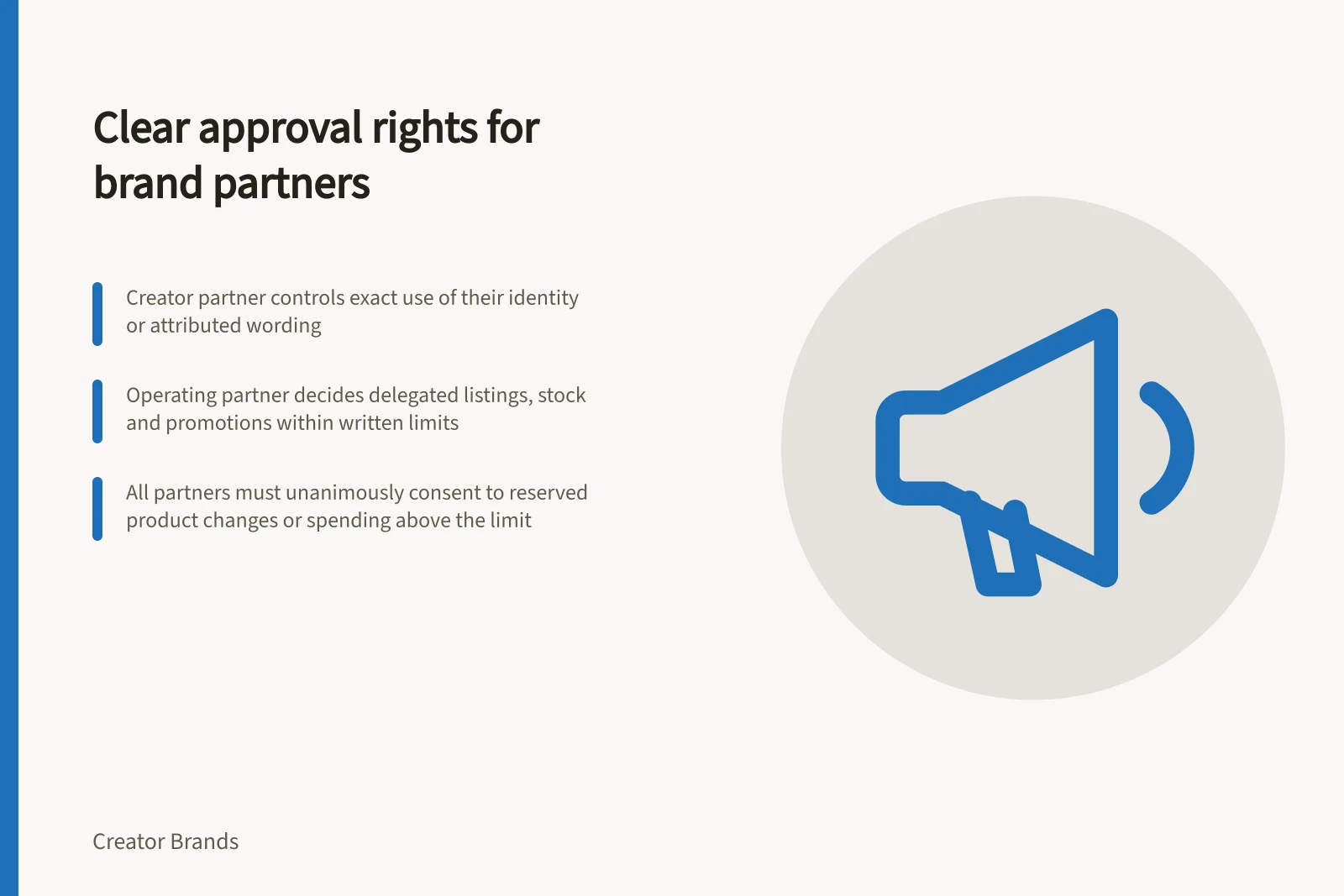
Give each recurring decision a route to a final answer. In this model, the creator partner controls permission for their exact attributed wording or recording; the operating partner handles delegated listings, stock and promotions; all partners decide reserved matters. Record the allocation in the governing agreement, which takes precedence over an internal matrix.
Start with the rights already agreed
Identify the parties and assets involved in each decision. A shareholding, creator-asset licence, employment role and supplier contract may grant different rights; do not assume that every person called a partner has a vote on every decision.
A partnership is made up of 2 or more people who manage a business and share income or losses. In a general partnership, all partners are responsible for managing the business; in a limited partnership, general partners manage it and limited partners are passive investors who do not manage day-to-day operations.
business.gov.au names the partnership statutes for each jurisdiction: Partnership Act 1963 (ACT), Partnership Act 1892 (NSW), Partnership Act 1997 (NT), Partnership Act 1891 (Queensland, South Australia and Tasmania), Partnership Act 1958 (Victoria), and Partnership Act 1895 (Western Australia). Each state and territory has its own partnership laws, so check the applicable agreement and law before assigning approval rights.
Key legal frameworks for partnerships in Australia
Assign a route by decision type
Use the matrix as an agreed allocation, where the legal arrangement permits it. The operating partner decides delegated matters; the creator partner gives consent to the exact use of their identity or attributed statement; all partners decide reserved product changes and spending above the written delegation.
| Decision | Who decides | Consent required | Urgent route |
|---|---|---|---|
| Verified listing error | Operating partner corrects and records it if the error and replacement wording are supported | Creator partner, if the change alters attributed wording or use of identity | Operating partner can pause questionable live copy while checking it |
| New attributed creator statement | Operating partner submits the exact wording or recording and checks factual claims | Creator partner consents to the exact wording or recording; consent does not prove a product benefit | Do not publish while consent or claim support is outstanding |
| Product specification change | Operating partner assesses the proposed version; all partners decide whether to release it | Unanimous consent from all partners | Operating partner can hold sales of the affected version pending assessment |
| Spending commitment | Operating partner decides within the written delegated limit; all partners decide above it | Unanimous consent above the limit | Do not commit spending above the limit before consent |
| Possible safety concern or unsupported live claim | Operating partner can temporarily pause the affected sale, promotion or claim | No consent is needed for the temporary pause; a permanent product change follows the product-specification route | Hold the affected activity while evidence or a qualified assessment is obtained |
Define which product versions, channels and spending amounts each route covers. Record the delegated limit in the agreement; an approval for one version or use should not silently carry over to another.
Plan for disagreement and urgency
For a reserved decision, send the proposal and supporting evidence to the partners and take any disagreement to a partner meeting. If unanimous consent is still not reached, apply a no-change rule: the proposal fails and the current approved version or spending limit remains in place.
A safety hold is different from a deadlocked product decision. Keep the affected sale or promotion paused while the concern is assessed; do not treat urgency as permission to make a permanent product change without the required consent.
The ACCC can require businesses to back up product or service claims and may investigate and take compliance or enforcement action if a business misleads. It does not resolve individual disputes about misleading claims or provide legal advice; it also does not test products for safety or compliance or advise which standards apply.
Keep a decision record with the proposal, evidence, affected version, required consents, conditions, date and action taken. Revisit the matrix when a partner joins, an asset licence changes or a new channel creates decisions the existing routes do not cover.