Team Design
Part of Creator brand team design
Choosing the first operational hire for a creator brand
Find the operational constraint before choosing a first hire. Define outcomes, selection criteria, authority and the appropriate working arrangement.
Choose the first operational hire by tracing the recurring work that most limits the brand’s ability to deliver its promises. Record the work and its consequences before settling on a title, then define the result the person must own and assess the working arrangement against the actual work. A general “right hand” can absorb miscellaneous tasks while stock, fulfilment or customer issues remain unowned.
Diagnose the constraint
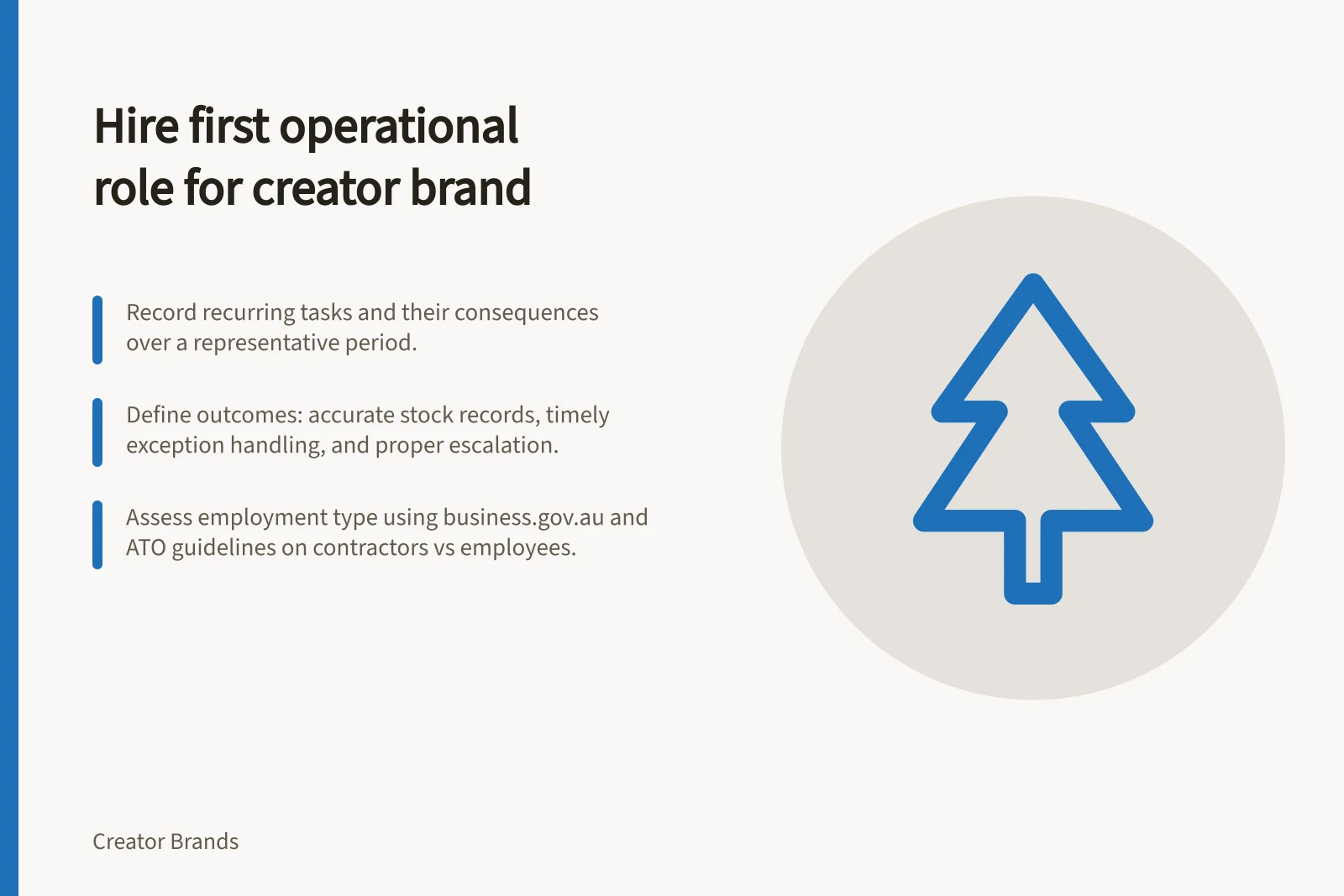
Over a representative working period, record each operational task, its frequency, time required, deadline and the consequence if delayed. Note which tasks depend on the creator or current operator and which could transfer with instructions. Separate a temporary launch spike from work expected to continue.
Group the evidence by problem. Orders waiting on stock coordination may point to an operations role, while a specialist product or manufacturing question may require qualified expertise. A service queue may point to a need for customer support capacity.
These are possible diagnoses, not a universal hiring order. State the result the first hire should improve and the work another person will stop doing.
For example, if the task log shows orders waiting on stock coordination, make current order and stock records and timely handling of routine fulfilment exceptions the role’s outcomes. At review, check that records are current, fewer cases are unowned and exceptions are escalated on time.
Write the role as an outcome
Specify the decisions and results the person will own. They might maintain an accurate order and stock record, resolve routine fulfilment exceptions within agreed authority, and escalate product concerns to a named specialist. State what they may change, the systems they need, who manages them and which approvals remain elsewhere.
Tie selection criteria to the actual work. Ask candidates what information they would seek if an order could not be fulfilled as advertised, and when they would escalate. Assess their reasoning and relevant experience; a large creator following does not establish operational skill.
Define what success looks like in the first review period. Fewer unowned cases, current records and timely escalation may matter more than a long task list. Do not make someone responsible for a process while withholding its records or authority.
Choose the arrangement for the real work
The business.gov.au Guide to hiring employees recommends working out what the business needs and considering the type of employee that best meets those needs before deciding on employment type. It also directs employers to assess pay rates and conditions, super and tax obligations, and workplace impacts.
Assess the applicable pay rates and conditions, entitlements, tax, superannuation and workplace requirements when working out the cost of an employee. Check the requirements for the role before deciding which arrangement fits.
The business.gov.au page “Employee or contractor?” says classification is not decided by an ABN or an invoice; several factors matter. In general, contractors run their own business, while employees work in someone else’s business, where the employer controls how, where and when the work is done.
That page points to the Fair Work Ombudsman’s independent contracting guidance and the ATO’s information on employee and contractor differences, tax and super. Use that guidance when assessing the relationship, and consider independent legal advice if you are still unsure.
The page says incorrectly treating an employee as a contractor is sham contracting and illegal. Short-term work or a specific project does not automatically make someone a contractor.
Prepare the handover
Give the hire current product information, an escalation list, approved customer wording and access appropriate to their tasks. Introduce them to the supplier, fulfilment and service contacts they will use. Keep a named decision-maker available while they learn the business.
At the first review, check whether work was genuinely transferred. If every routine question still returns to the creator, revise the authority or information flow. If the need was only a short launch peak, reassess a continuing role before committing to it.