Launch Economics
Creator brand launch economics
Plan a creator product launch around order contribution, cautious stock scenarios, cash timing and support capacity.
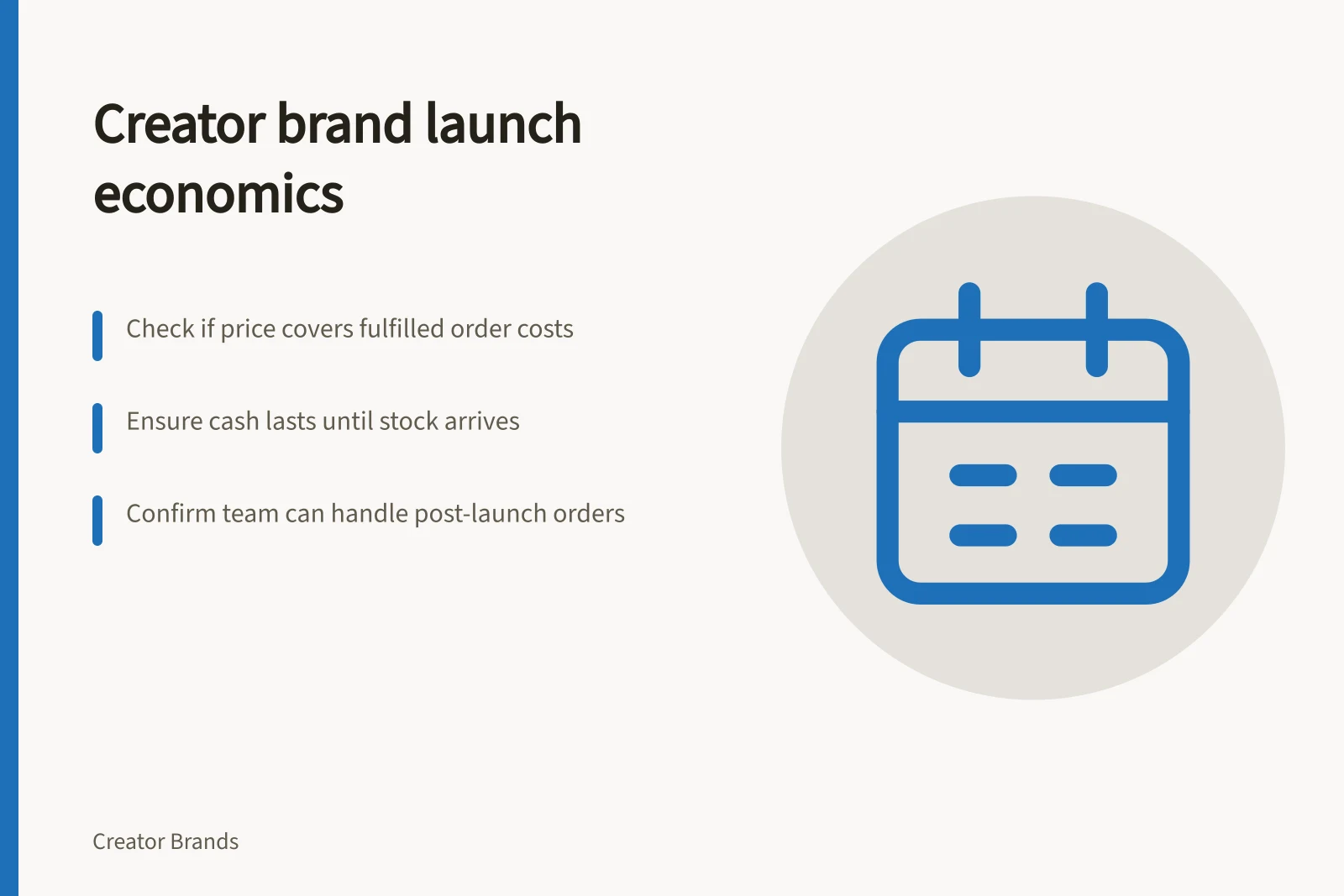
Before launching a creator product, check four things together. Check whether the proposed price covers the costs of a fulfilled order, and whether the first stock commitment is affordable under cautious demand. Check whether cash lasts until receipts arrive, and whether the team can handle orders after the announcement. Follower count answers none of these questions.
Test assumptions before production
Before committing to production, describe the product and the problem it solves, then check the idea with potential customers. Research similar products to identify what customers value and what could be improved. Surveys or interviews can help distinguish informed interest from general enthusiasm.
A basic prototype can expose product problems before they become production costs. Let potential customers try it. Observe how they use it and ask what they would change. Use that feedback to refine the offer and test whether its proposed price and product description still make sense.
Pre-Launch Validation Process
- Define product and problemClarify core value proposition and target user pain point
- Research similar productsIdentify customer preferences and improvement opportunities
- Test with potential customersUse surveys, interviews or prototypes to validate interest and usability
- Refine offer based on feedbackAdjust pricing, description and features before production
Start with an order
Choose a product, sales channel and typical order. Record revenue on a consistent tax basis, including any delivery charge collected from the customer. Subtract the saleable product cost and costs caused by the order: packaging, payment processing, picking, packing, delivery and routine support.
Show paid acquisition separately if it is needed to obtain the order. The remainder is contribution per order, as defined by the costs included. It is not net profit. Development, software, storage, staff and creator payments may still need covering.
Use current quotes and the proposed offer. Recalculate for a discount, a single-item order with subsidised delivery and a costly destination. Keep refunds and returns in a separate scenario, accounting for lost revenue, return freight and any unit that cannot be resold without counting the same loss twice. Check current ACCC guidance on price displays before publishing the offer.
Key Launch Economics Metrics
- Contribution per order
- Revenue minus product cost, packaging, delivery, payment processing, and support
- Cash flow risk (low scenario)
- Projected lowest closing balance after all costs and payments
- ACCC compliance
- Price displays must comply with ACCC guidelines on transparency
Size the first commitment
Separate completed orders and supportable paid commitments from waitlist entries, enquiries and engagement. Record the product, price and terms each group saw. Do not multiply a response rate from a small or self-selected group by the full follower count.
Set low, working and high order scenarios for a stated sales period and each variant. Compare them with supplier minimums, lead time, expected saleable units and the cash tied up if the low case occurs. Units held for checks, samples or existing orders are not free to fulfil new orders. A larger run may reduce some unit costs while increasing cash at risk; the decision depends on both effects.
Check production and delivery assumptions
Compare suppliers on price, quality, reliability, sustainability and delivery times, not price alone. Confirm how the product will be made and whether any applicable safety rules or standards can be met before treating a supplier quote or production plan as launch-ready.
Treat the delivery provider as a supplier: compare quotes, shipping times, express options, parcel sizes and weights, pickup arrangements and terms for lost or damaged packages. Check whether extra insurance, reporting or ecommerce integration is available, and whether overseas shipping is part of the offer.
Choose a customer shipping charge that fits the products and the costs behind it. Free shipping can suit small products of similar size when costs are predictable; flat rates are simpler for similar parcels, while varied sizes or weights can make a flat rate undercharge some orders. Tiered rates can combine a charge on smaller orders with free shipping above a threshold.
Shipping Charge Options Comparison
- Free shipping
- Best for small, consistent-sized items with predictable costs
- Flat rate
- Simpler for similar parcels; may undercharge for heavier or larger items
- Tiered rates
- Charge smaller orders, free shipping above threshold – balances cost and appeal
Forecast cash when it moves
Production deposits, packaging and freight may be payable before customers order. Put supplier payments, development, advertising, storage, fulfilment and support beside expected receipts in a dated forecast. Show the opening balance and the lowest projected closing balance for each scenario. State whether figures include or exclude GST and use that basis consistently.
Set a cash limit before ordering stock. If the low case leaves too little to dispatch orders and resolve problems, reduce or reschedule the commitment or arrange funding. Customer payments for future supply must still cover the costs of fulfilling those orders.
A cash flow statement can help identify payment cycles and seasonal trends. Label estimated costs clearly and consider when each source of income and major cost will actually arrive or be paid. Revisit the forecast as estimates become actual figures.
Launch Cash Flow Forecast Timeline
- Production deposit payable
- Before customer orders received
- Packaging and freight costs
- Often paid upfront, before sales revenue arrives
- Customer receipts expected
- After order confirmation and delivery timeline
- Revisit forecast regularly
- As actual figures replace estimates
Allow for work after checkout
An order can generate packing, tracking, enquiries, delivery exceptions and remedies. Name who handles each task, estimate peak capacity and include routine work in the order calculation. Budget separately for less common problems. Check current ACCC guidance on consumer rights and remedies, and give buyers clear delivery information and update affected customers when a known delay arises.
Record the launch decision
| Question | Evidence | If unresolved |
|---|---|---|
| Does the price leave enough contribution? | Current product and order costs at the proposed terms | Revise the price or offer |
| Can the first run be funded in the low case? | Supplier terms and a dated cash forecast | Reduce the order or change funding and timing |
| Can each offered variant be supplied as described? | Saleable, unallocated stock and a supported dispatch plan | Hold the variant or change the offer |
| Can the team handle opening orders? | Named fulfilment and support owners with peak capacity | Limit opening volume or add capacity |
After opening, compare actual revenue, order costs, cancellations and support work with the assumptions before committing to more stock or spending.
Creator Brand Launch Readiness Checklist
- Does the price leave enough contribution?Yes – based on current product and order costs at proposed terms
- Can the first run be funded in the low case?Yes – confirmed via supplier terms and dated cash forecast
- Can each offered variant be supplied as described?Yes – with saleable, unallocated stock and supported dispatch plan
- Can the team handle opening orders?Yes – named fulfilment and support owners with peak capacity identified
In this guide
- Calculating contribution margin before announcing a priceCalculate per-order contribution before announcing a creator product price, including product, payment, delivery and support costs.
- Estimating stock needs without equating followers with customersEstimate first-run stock from buying evidence, saleable units, supplier limits and cautious demand scenarios.
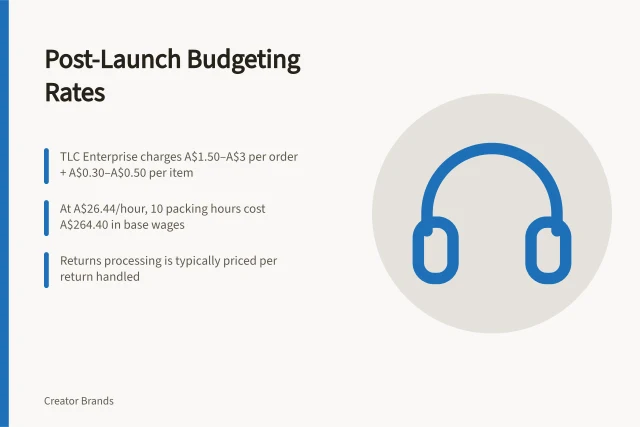
- Budgeting for support and fulfilment after launch: ratesPlan post-launch packing, delivery, customer support and remedy costs, including peak capacity and fixed commitments.