Product Development
Part of Creator brand launch economics
Estimating stock needs without equating followers with customers
Estimate first-run stock from buying evidence, saleable units, supplier limits and cautious demand scenarios.
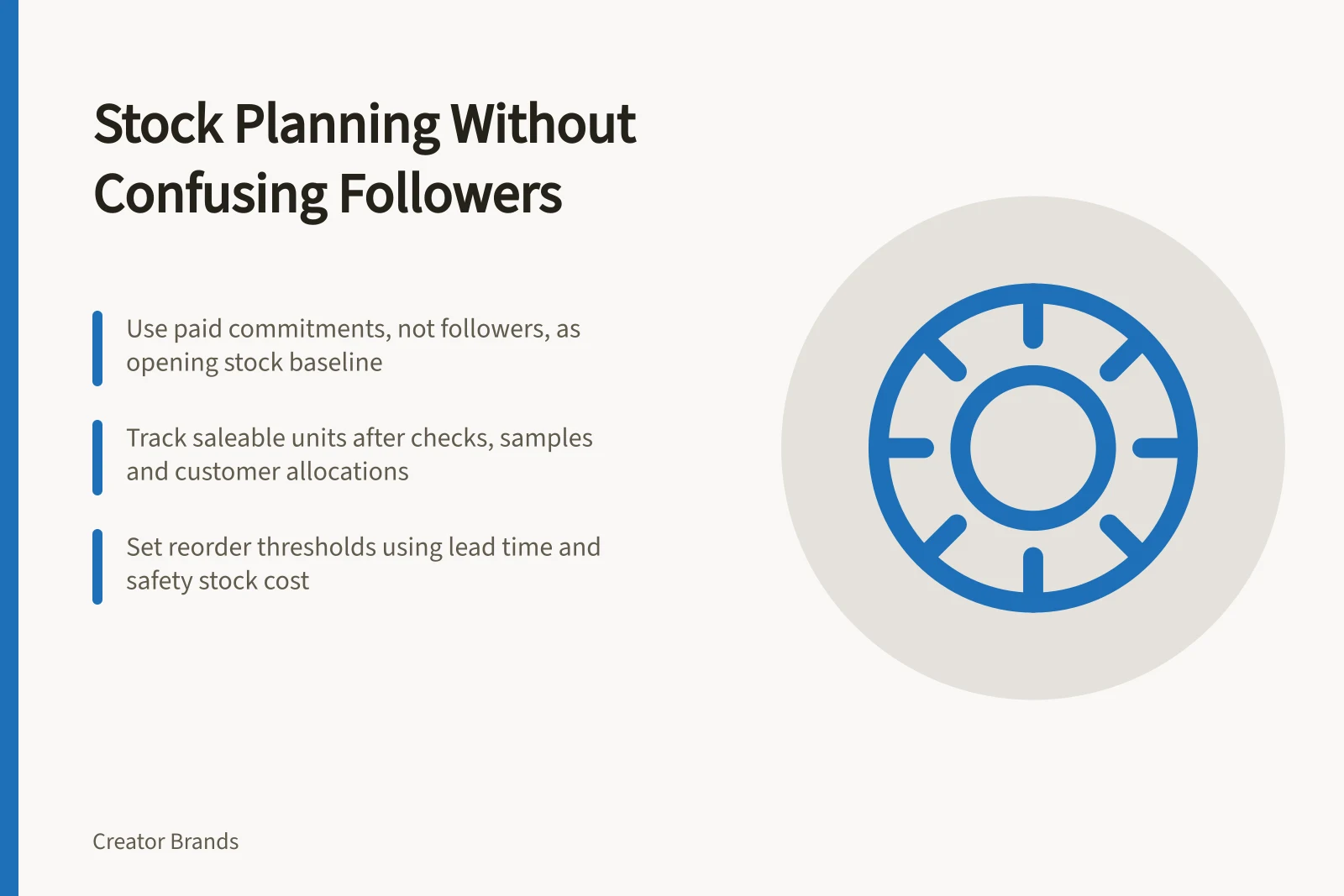
Estimate opening stock separately for each variant: cover supportable commitments, then add only the extra units you can afford to hold. For a first D2C run with no sales history, use paid commitments as the baseline; followers and waitlist entries are not unit forecasts.
Define the quantity that matters
Record the product version, each variant, the opening sales window and the earliest date replenishment could be ready to sell. Ask the supplier for minimum quantities, payment dates, lead time and whether each variant can be reordered separately.
Separate units ordered from units expected to pass checks and units reserved for samples or holds. Saleable units are what remains after those deductions; existing customer commitments also need to be allocated before calculating stock available for other orders. A factory completion date is not a dispatch date, so keep inspection, transport and receiving uncertainty visible.
Weigh buying signals
Count supportable, paid but unfulfilled orders for each variant as commitments to supply. Completed eligible orders can show sales pace when they match the product version, price, delivery proposition and sales window, but do not count already fulfilled orders again as opening commitments.
Keep waitlist entries, page visits, survey answers and comments separate from order quantities. Record the price, product version and delivery proposition each group saw, since a changed offer is a different signal.
Follower count may describe possible reach, but it does not establish who saw the offer, accepted the price or wanted a particular variant. Do not turn followers or waitlist entries into estimated buyers.
Build a range for each variant
For each variant, set the opening order quantity as commitments plus any extra stock you deliberately choose to risk, plus units that will be held back for checks, samples or other holds. With no sales history, the low case is commitments plus holds, with no speculative units; any extra stock is a cash-risk choice, not a conversion estimate.
If you choose extra units, set a maximum cash amount you are willing to tie up in them. Allocate those units by variant only where commitments give you a basis for the mix; if there is no basis, leave the speculative allowance at zero rather than inventing a split.
Manufactured units are not all available to sell. For example, 100 units made, less 10 held for checks and five allocated as samples, leaves 85 before existing customer commitments.
If a supplier minimum pushes the order above your baseline, treat the excess as speculative stock. Cost that excess against your risk allowance, or do not place an order that exceeds what you can afford.
Calculate affordability using the cash due, not just the selling price. Let each variant’s unit cash cost include relevant supplies, manufacturing, packaging and other production costs; record amounts in AUD and state consistently whether they include or exclude GST.
Forecast cash by payment date: closing balance equals opening balance plus cash incoming minus total cash outgoing. Include each stock payment when it falls due and check that other payments remain covered; for payments due together, the total order cost must not exceed cash available for stock.
Key Financial and Inventory Metrics for Stock Planning
- Unit cash cost (AUD)
- Includes manufacturing, packaging, supplies – state if GST included
- Supplier lead time (days)
- From order to dispatch; factor in inspection and transport
- Safety stock cost (AUD)
- Units × unit cash cost – only if affordable
- Maximum cash at risk
- Speculative stock limit set by business affordability
Set a reorder review point
For each variant, calculate a review threshold as average daily eligible sales multiplied by supplier lead time in days, plus safety stock. This gives the units needed to cover expected sales while replenishment is prepared.
A first run has no pre-launch sales history, so begin tracking eligible sales and saleable stock by variant. Set safety stock only at a quantity whose cash cost you can afford; the cost is the safety-stock units multiplied by that variant’s unit cash cost.
Review a variant when its saleable stock approaches the threshold, and order only the quantity needed to reach your chosen stock target, subject to the supplier minimum and cash available. A fast-selling variant does not establish demand for a slow one.
Reconcile store quantities with physical stock, orders, cancellations and returns. If sales are slow, revisit cash exposure before reordering; if sales are fast, verify the next batch and dispatch promise before taking further payment.