Brand Positioning
Part of Creator brand ownership and partnerships
Reviewing who owns the brand and product assets
Trace who holds and may use a creator brand’s trade marks, artwork, content and product assets as a partnership changes.
undefined
Review the assets a creator product business depends on, one by one. A registered trade mark, packaging artwork, creator photograph, product drawing or online account may have a different rights holder, and holding a file, login or invoice does not establish who may use it during the partnership or after it ends.
Build a rights register
For every asset and version, record the claimed rights holder, supporting document, permitted user and use, expiry, and any gap to resolve. The register should name the person or entity holding a right, not just the public-facing brand.
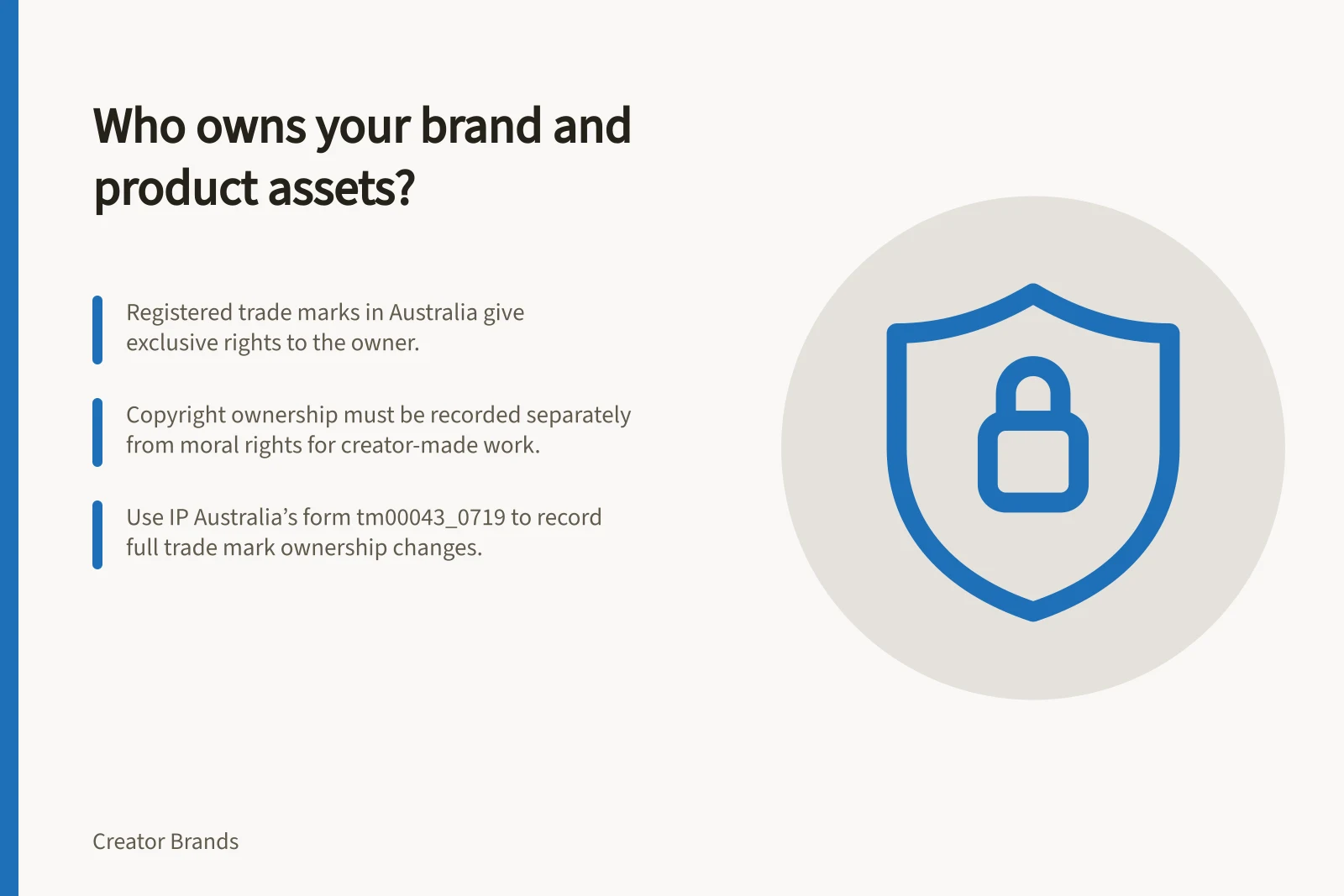
Include product and range marks, logos, and registered or pending trade marks. Trade marks can protect words, logos and aspects of packaging; registration generally gives stronger protection than an unregistered mark. A registered trade mark gives its owner exclusive rights to use it in Australia and the ability to sell or license it.
Record copyright as a separate rights category to check for photographs, packaging artwork, video and copy. The Copyright Act 1968 (Cth) covers artistic, musical, literary and dramatic works, as well as subject matter including films, sound recordings, broadcasts and published editions. Record the creator, claimed owner and contract or licence governing each asset; see the Attorney-General’s Department’s Copyright basics and For copyright owners.
Copyright ownership is distinct from moral rights. Moral rights include attribution, protection against false attribution and integrity; they belong to the individual creator and concern how the creator is identified and how the work is treated. Record the agreed credit and treatment of creator-made material separately from who owns its copyright.
For a product shape, keep design rights distinct from trade mark claims. The Designs Act 2003 concerns design rights; registering a container’s shape or configuration as a design does not necessarily mean it is adapted to distinguish goods as a trade mark. Register any relevant design right separately from the trade mark claim.
Trace each right to its source
Separate material held before the collaboration, material created for it, and third-party material. IP Australia’s IP management for collaborations calls these background IP, project IP and third-party IP. Locate the registration, contract, assignment or licence for each asset and check that it names the right parties and covers the intended uses, timeframes and any sublicensing.
For project IP, the partners can agree that one party or both parties own it. Specify who may use and manage each asset the collaboration creates, including other material produced alongside the project IP. If third-party IP is included, its owner must agree to its use.
A registered trade mark belongs to its registered owner. To transfer it, the current owner (assignor) and proposed owner (assignee) need an agreement signed by an authorised person; the agreement should state whether the assignment is full or partial and clearly transfer title. IP Australia’s How to assign ownership of a trade mark explains that the agreement enacts the transfer; recording it on the trade marks register does not.
After assignment, either party can ask IP Australia to record the change on the trade marks register, with supporting evidence. For a full change of ownership, IP Australia provides the Request For Full Assignment Or Transmission Of A Trade Mark (Full Change Of Ownership), form tm00043_0719, which can be submitted through online services or by post.
For work made by employees or contractors, check the written terms. IP Australia’s Who owns intellectual property? says employers own IP employees create in relation to the business, while IP created by a contractor belongs to the contractor unless the contract states otherwise. Apply that check to contractor-made websites, designs, drawings, databases, logos and other commissioned material rather than assuming payment transferred ownership.
If evidence is missing or conflicting, mark the asset unresolved. Do not treat an asset as cleared merely because a version is already in use.
Ownership of IP: Employee vs Contractor work
- Employee-created IP
- Employer owns the IP if created in the course of employment
- Contractor-created IP
- Contractor owns the IP unless a written agreement assigns it
Test changes to the arrangement
For a new sales channel, check whether permission covers the retailer’s listing, pack image and creator portrait. Confirm whether the retailer or its agency may use any third-party material.
For a revised product, check who may change the drawings or packaging and whether the existing licence covers the new category. Record any agreed use of the creator’s identity and any limits on using or changing creator-made material.
If a partner exits, check which assets the business may still use to sell permitted remaining stock and support existing orders. Record when use of the creator’s mark or images must stop and who retains the records needed to answer those questions.
For each change, record the agreement clause or other evidence that supports the permitted use. A permission for one image or product version should not be assumed to cover another.
Resolve the rights that keep the business running
Prioritise assets that would be difficult to replace while orders, stock or supplier commitments remain active. Confirm the registered rights holder, obtain written terms for commissioned work and identify limits on third-party material. Keep each approved asset version with its supporting document.
For every essential asset, the register should answer who holds the relevant right and what the business may do with it. Seek qualified IP advice where contracts conflict, ownership is contested or an essential permission is missing.