Manufacturing
Creator brand manufacturing
Plan a creator product’s manufacturing handover, from a shared brief and supplier agreement to production checks and accepted units.
Creator brand manufacturing turns an agreed product design into units the business can supply as described. Decide on a capable producer, control the specification, check production and identify which units are ready to fulfil orders. Set a firm dispatch promise from those decisions, not from a factory estimate alone.
Define the item to be made
Give potential manufacturers the same brief: intended use, materials or contents, dimensions, variants, packaging, instructions and features that matter most to the buyer. Mark unresolved choices. A sample without written details leaves room for different interpretations.
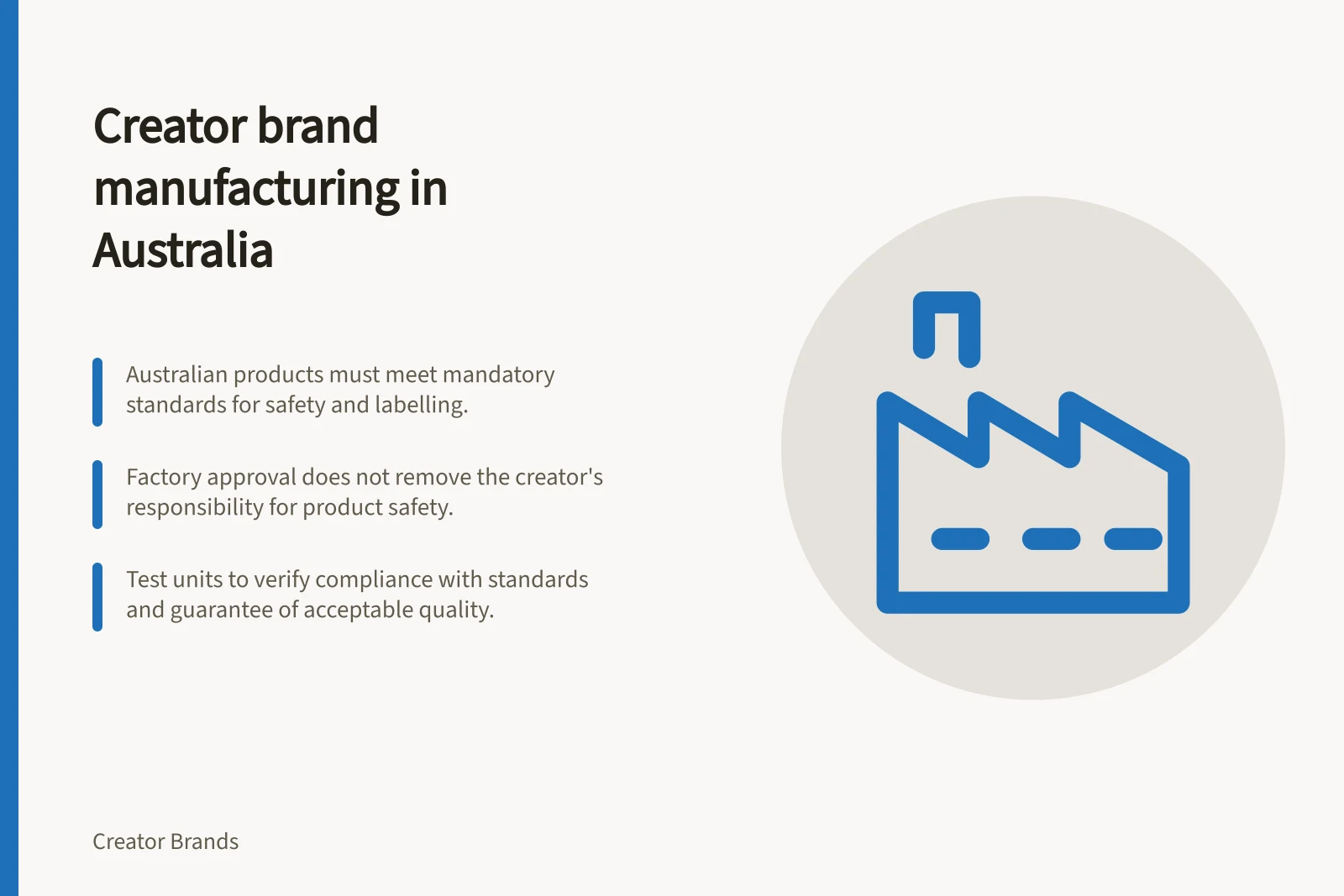
Check Australian requirements for the exact product before committing to production. Mandatory standards, bans and information requirements vary by category; a product may also need other specialist checks. Creator approval of a design does not establish safety or compliance.
Mandatory standards apply only to certain products and set compulsory requirements for their legal supply in Australia. Depending on the product, they can cover performance, composition, contents, manufacturing or processing methods, design, construction, finish, packaging or labelling.
Information standards can also require information that helps consumers decide whether to buy. Examples include ingredient labelling for cosmetics and care labelling for clothing and textiles.
The ACCC says mandatory standards and bans are made when evidence shows a high risk of serious injury, serious illness or death. Check current standards, bans and recalls through the ACCC’s product safety emails before the release decision.
Choose a production partner
Choose a producer with relevant capability and clear responsibility for the units and any changes. Put the main commercial and quality terms in writing before production.
Control the handover to production
Keep the approved specification and reference sample for each relevant version and variant. The manufacturer should acknowledge the production version before starting.
Agree how production will be checked and which changes need fresh approval. Sample approval does not establish that later units will be identical, so review testing if the design, material or method changes.
| Point in the process | Decision to record |
|---|---|
| Before ordering | Is the item specified, and have its category requirements been identified? |
| Before production | Are the reference, specification and change process agreed? |
| Before shipment | Have agreed inspections and any applicable test requirements been addressed? |
| Before fulfilment | Which identified units have been accepted for supply? |
Identify acceptable units
Review production against the agreed specification and inspection criteria. Separate accepted cosmetic variation from a functional fault, a misleading description or a possible safety issue. Hold affected units while the business investigates.
Australian consumer product suppliers retain responsibility for product safety even when another business makes the goods. A factory approval does not remove that obligation.
Testing can help establish whether a product meets a mandatory standard or falls within a ban. It can also reduce the risk of injury, death and costly recalls.
Testing may also be required to establish whether goods meet the guarantee of acceptable quality.
Testing may also be required to substantiate claims about environmental impacts, emissions or efficiency; ingredients, components or allergens; country or place of origin; technological modification; or health benefits and impacts.
Supplying goods that fail to meet a relevant mandatory standard is an offence. The ACCC may take enforcement action under the Australian Consumer Law. Non-compliance can lead to costs such as repairs, replacements or refunds, product redesign and lost business.
Connect production to the customer promise
Allow for inspection, possible rework, freight, receipt and order processing when setting dispatch timing. Confirm the accepted variants and quantities before describing stock as ready to dispatch.
A clearly described later-supply offer is a different state. The ACCC can investigate businesses that break the rules about accepting payment without intending to supply.
Keep the specification, approvals, inspection results, relevant test evidence, batch identification and supplier communications together. They support the decision to fulfil orders and help investigate later problems. If production slips, revisit the supply plan before making a new customer promise.
In this guide
- Choosing a manufacturer for a first product: a frameworkCompare first-product manufacturers on capability, quality evidence, sample work, timing and clear production terms before placing a run.
- Keeping approved samples and specifications documentedKeep a clear approved reference, current specification, change record and batch evidence so production can be checked against the agreed item.
- Reviewing product quality before a launch: release checksReview production units, test evidence, packaging and product claims before accepting stock to fulfil creator brand orders.
- Planning a backup when production is delayedSet triggers for a delayed creator product run, compare feasible production options and keep the live offer tied to verified supply.