Brand Positioning
Part of Creator brand reputation risk
Separating documented product complaints from online speculation
Preserve the claim, check product and order facts, assess patterns carefully and keep public conclusions within the evidence.
Assess a product complaint when it identifies something that happened to a customer or item. An online claim without checkable details remains unverified. Record both accurately, investigate what can be checked, and avoid treating either a rumour or a first report as a finding about every unit.
Preserve what was reported
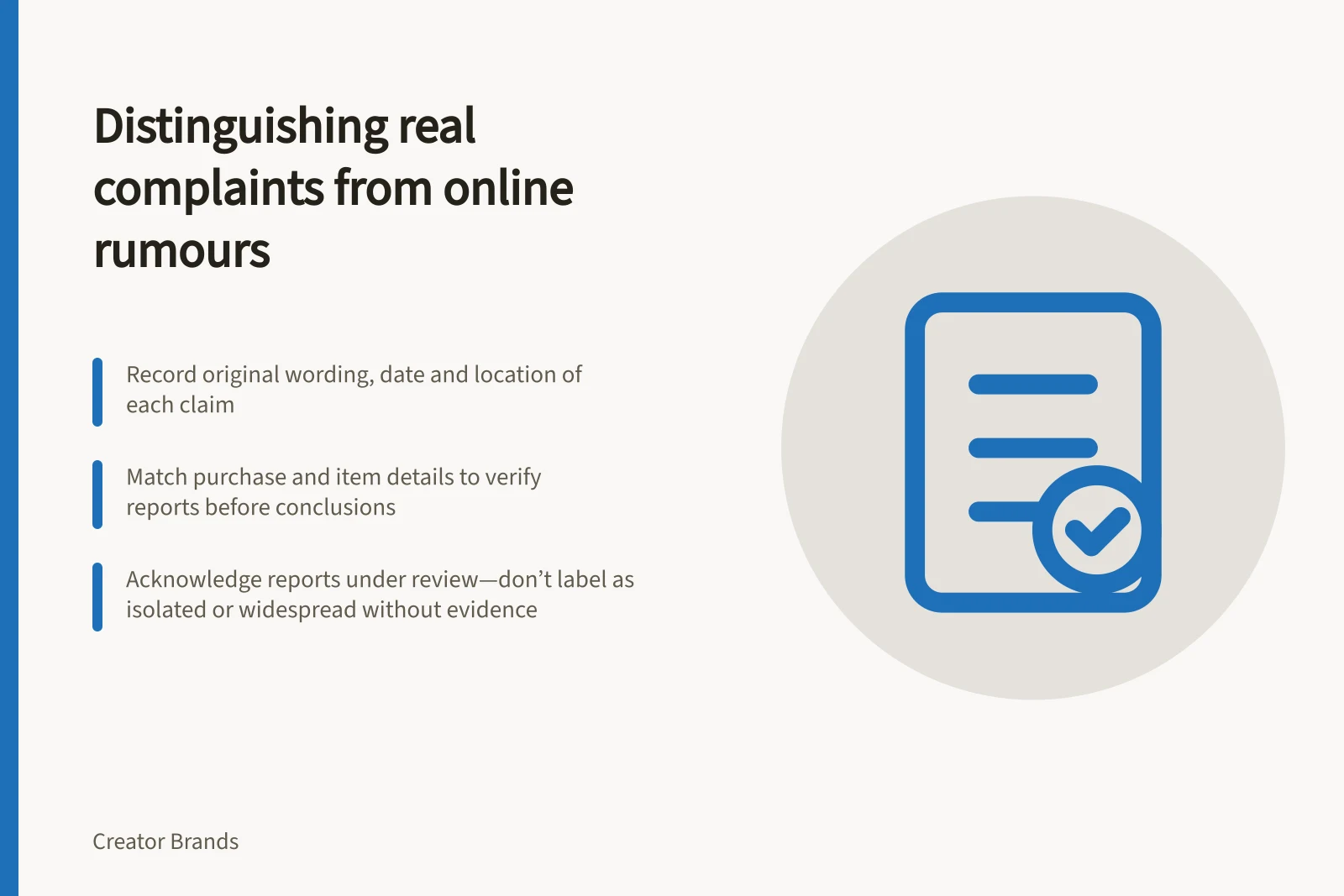
Record the claim’s original wording, date and location. Note whether the speaker describes first-hand experience, repeats another account or infers a cause. A screenshot establishes what appeared online; it does not verify the purchase, item or conclusion.
For a specific product report, seek purchase and item details privately, including the variant and batch if available. Keep the customer’s observation separate from a proposed explanation.
“The lid broke” describes an event; it does not, by itself, establish misuse or a manufacturing fault. The ACCC educates consumers and businesses about rights and responsibilities under consumer law, but it does not resolve individual disputes or give legal advice about a consumer’s right to a repair, replacement or refund for a faulty product or service.
Documented Complaints vs. Online Speculation: Key Differences
- Documented ComplaintFirst-hand account with product details (e.g., variant, batch), purchase date, and specific issue (e.g., lid broke).
- Online SpeculationAnonymous or unverified claim without checkable details; may repeat rumours or infer cause without evidence.
Match evidence to the question
| Material available | What it helps establish | What remains unknown |
|---|---|---|
| Anonymous repost without item details | A claim is circulating | Whether an incident occurred or which item is involved |
| First-hand account identifying an item | A case needs follow-up | The item’s condition, purchase details and cause |
| Order and product records matched to the report | Which version was sold | Whether other units share the issue |
| Inspection or qualified assessment | Findings for the goods examined | Whether the findings apply beyond that scope |
This is an investigation aid, not a set of requirements a customer must complete before receiving help. Escalate a credible safety report promptly even while its cause remains uncertain.
How to Investigate a Product Complaint
- Preserve the original reportRecord wording, date, location, and whether it's first-hand, second-hand, or inferred.
- Verify purchase and item detailsMatch order records and product variants to the report; keep observation separate from explanation.
- Assess evidence against the questionDetermine what can be proven (e.g., defect in tested unit) versus what remains unknown (e.g., broader impact).
- Look for patterns without assuming ratesGroup reports by issue, version, batch, and date; avoid calculating defect rates without full data.
- Communicate results within scopeAcknowledge checks are underway; avoid terms like 'isolated' or 'widespread' without evidence.
Look for a pattern without inventing a rate
Group reports by observed issue, product version, batch where known, channel and date. Keep vague mentions separate from cases that can be compared.
Several similar cases may justify checking retained stock, packing records or the live description. A count of reports is not a defect rate when the number of relevant units and reporting conditions are unknown.
For a claim that the item differs from its advertising, compare the relevant listing or promotion with the version supplied. Australian guidance requires business product claims, including social media descriptions, to be accurate and supportable. Correct an inaccurate business claim where buyers encounter it while individual cases are assessed.
State the result within its scope
A public reply can acknowledge that reports are being checked and direct buyers to a private service route. Say which product or variant is under review only when that scope is known. Do not call the issue isolated, widespread or false before the evidence supports that conclusion.
Do not suppress genuine negative reviews to protect the creator. The ACCC accepts reports about fake or misleading online reviews as well as review manipulation, and it can investigate if a business misleads people in relation to online reviews.
Close an investigation record as confirmed, not substantiated on the evidence examined, or still open; explain the scope of the check. Decide each customer’s order separately under the applicable facts and rights.
ACCC Guidance on Consumer Rights and Reviews
- Consumer Law CoverageRepair, replacement, refund or cancellation rights apply for faulty products under Australian consumer law.
- Review IntegrityThe ACCC investigates fake or misleading online reviews and review manipulation.
- Product SafetyBusinesses must recall unsafe products through the Australian Product Safety Regulator.