Launch Economics
Part of Creator brand launch campaigns
Explaining availability without artificial scarcity
Describe first batches, preorders, waitlists and restocks clearly without artificial scarcity or conflicting countdown claims.
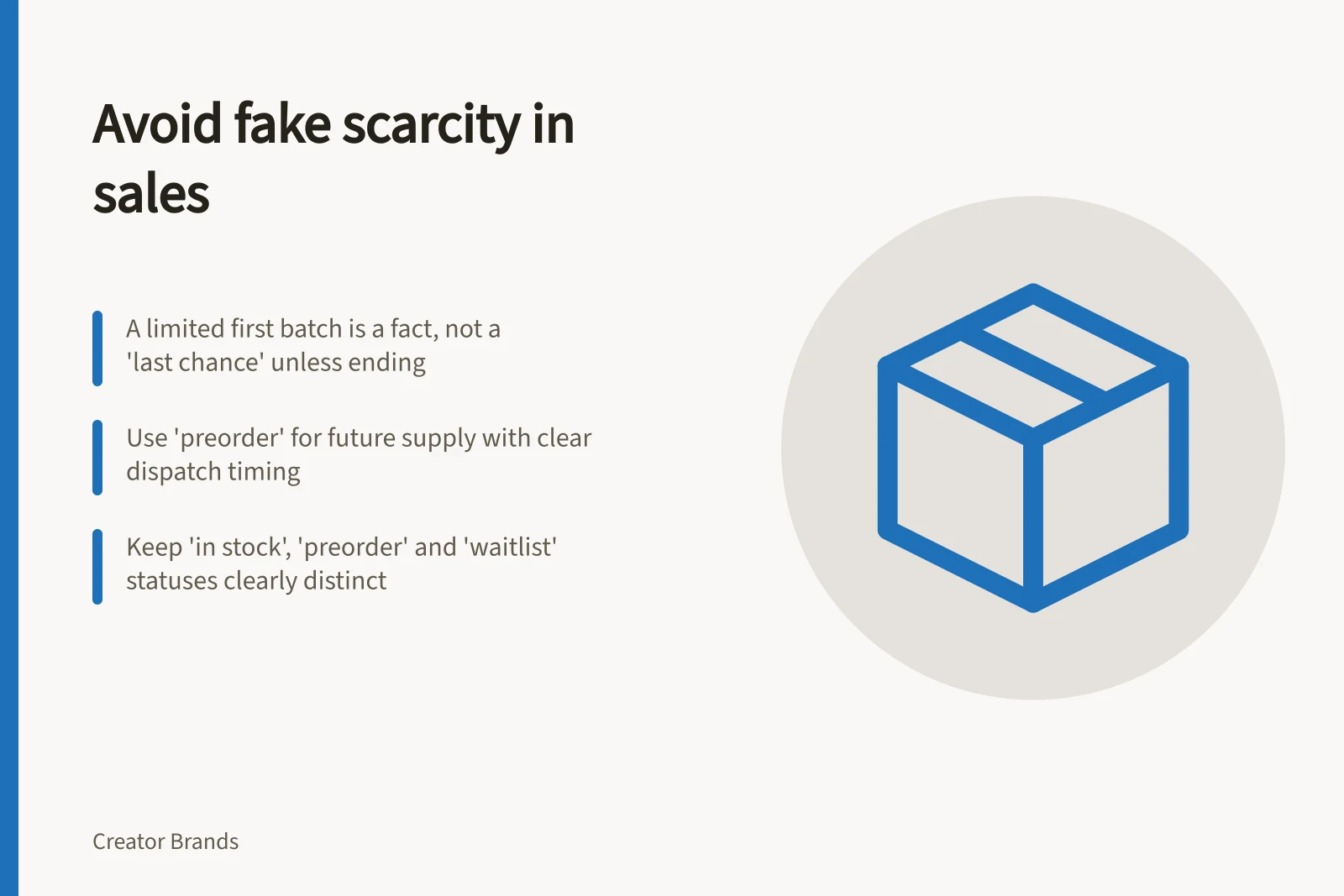
Tell buyers what is available, when they can order it and what remains uncertain. A limited first batch is a fact. “Last chance” is a separate claim: use it only when the opportunity really is ending. Creator brands can create urgency by giving people accurate information in time to decide.
ACCC Guidance on Misleading Scarcity Claims
- ACCC investigation into Black Friday claims
- Ongoing as of October 2026
- False or misleading claims under scrutiny
- Common in promotional advertising
Name the actual constraint
Before writing a scarcity message, identify the thing that is limited. Is it the quantity of finished units, one variant, the order window, a launch offer or the business’s current ability to dispatch? Each calls for different wording.
A small batch does not mean the product will never return. A closed discount does not mean the product will disappear.
If the first run is finite, call it the first run and say whether another is planned, being considered or unknown. Do not promise a restock date that depends on unfinished production. Where quantities change quickly, a current stock status on the product page beats a precise number in a static creator post.
Keep sales states distinct
In stock: the business has saleable units allocated to the offer and can state a supported dispatch estimate. Preorder: a customer can pay now for later supply; the page should explain that status and the expected timing. Waitlist: a person registers interest or asks for an update; joining does not secure a unit unless the terms expressly say it does.
Keep the language distinct. “Available now” should not lead to a checkout for an uncertain future batch. “Reserved” should not describe a mailing-list sign-up. If the business cannot support a reasonable delivery estimate, collecting interest may be clearer than accepting orders.
Audit urgency across the whole journey
Read the creator caption, ad, product tile, product page and checkout in sequence. They should agree on what ends, when it ends and what remains available afterwards. A countdown that restarts, or a “final release” followed by a planned repeat, can create a false impression. The ACCC has identified potentially misleading timers that suggested a sale was ending when it continued.
Do not bury a key qualification where buyers are unlikely to see it. If the headline says “ships this week”, a small note saying “selected variants only” does not fix the mismatch for an excluded variant. Show the variant and timing beside the buying decision.
One wording test: would someone understand the offer from one post and the product page alone? If the answer depends on an earlier story or a later correction, rewrite the main message.
Plan for sell-through
Decide in advance who updates the page when a variant sells out and who pauses scheduled posts. Give the creator approved, accurate language for a sell-out: what is unavailable, whether a waitlist exists and when an update will follow. Do not treat an unexpected sell-out as proof of universal demand; it may reflect a small opening allocation.