Brand Positioning
Part of Creator brand launch campaigns
Sequencing product education before the sales announcement
Build a creator launch sequence that explains the product, resolves buying questions and announces sales only when the offer is ready.
Explain what the product is and how it works before asking people to buy it. For a creator brand, early attention often belongs to the person; the campaign must transfer it to a specific product decision. The sales announcement should be when an informed person can act, not the first time they learn what is being sold.
Key Compliance Points from ACCC Guidelines
- False or misleading claims
- Prohibited under Australian Consumer Law (ACL)
- Influencer transparency
- Must disclose paid partnerships clearly
- Social media promotions
- Must be fair, accurate, and not deceptive
Start with the questions a buyer must answer
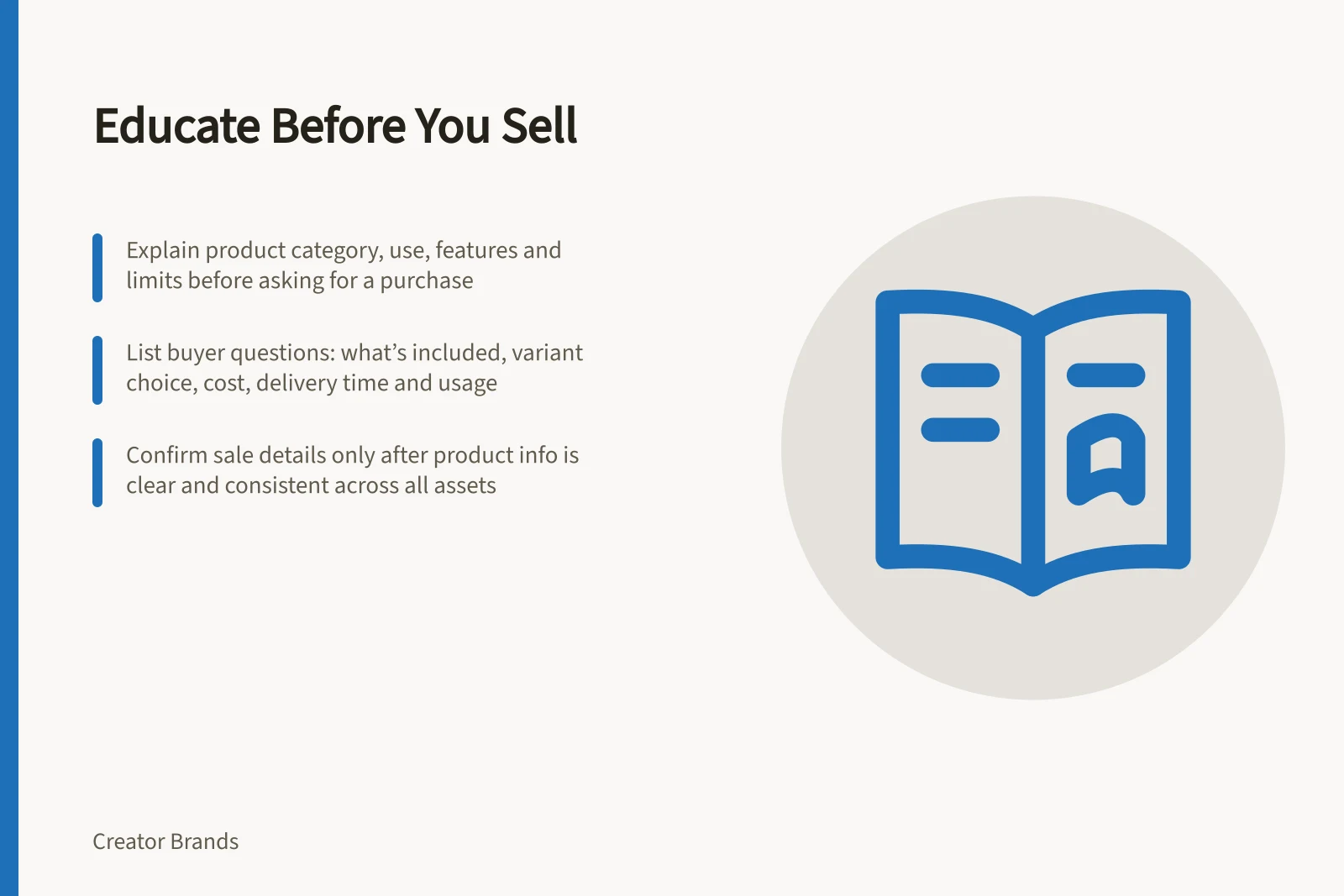
Write a brief product explanation without the creator’s name. It should identify the category, intended use, relevant features and limits. Then list the questions a buyer would need answered before ordering: what is included, which variant suits them, how to use it, what it costs and when they can expect it. Use those questions to choose demonstrations and product-page content.
The creator can explain the problem they wanted to address or show how they use the finished product. Keep the account precise. If the creator has handled a prototype, do not describe it as extensive use of the final production item.
If a result depends on conditions, say so. Product imagery and social posts should give the same impression as the item offered at checkout.
Move through three useful stages
Introduce the product. Show what it is and why it exists. A simple demonstration or clear image is more useful than a sequence of unexplained close-ups. At this stage, a date is optional; accuracy matters more than suspense.
Resolve buying questions. Explain variants, contents, limitations and practical use. Put durable answers on the product page so a buyer does not have to search through old stories. Collect questions from comments and support enquiries, then correct any repeated misunderstanding in the main description.
Announce the sale. Once product, stock and checkout details are confirmed, state the opening time, price, eligible variants, delivery estimate and any genuine limit. Send people to a page that carries the same information. If something changes, update both the page and the promotional assets that still circulate.
These are decision stages, not fixed days in a content calendar. A straightforward product may need little explanation; an unfamiliar one may need more. Do not add posts simply to prolong anticipation.
Make each asset earn its place
A useful review question is: what can a viewer decide after seeing this piece that they could not decide before? A demonstration can show scale or method of use. A comparison can explain two variants.
A founder story can explain an actual design choice. Repeating “something is coming” provides little help once interest exists.
Before publication, have someone unfamiliar with the creator look at the product page and one planned post. Ask them to describe the item, its likely use and any uncertainty that would stop them ordering. Treat their answers as feedback on clarity, not as evidence of demand. Purchase intent needs separate testing.
If launch timing slips, keep accurate educational material available and pause sales language. State when the next update will be given. That preserves the distinction between learning about a product and being invited to pay for one.